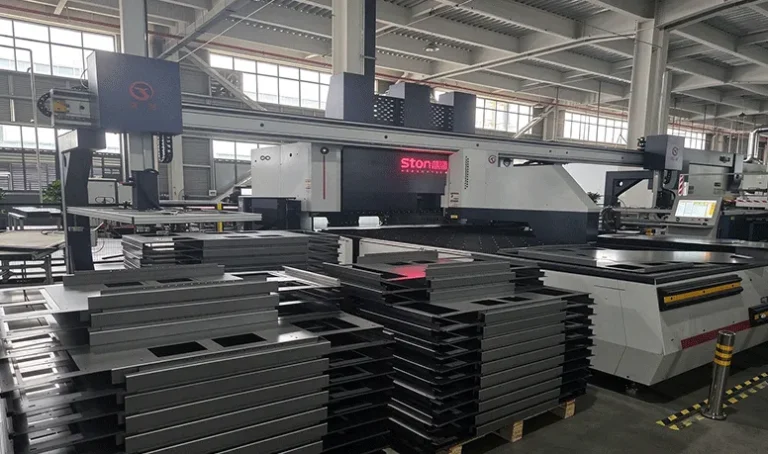
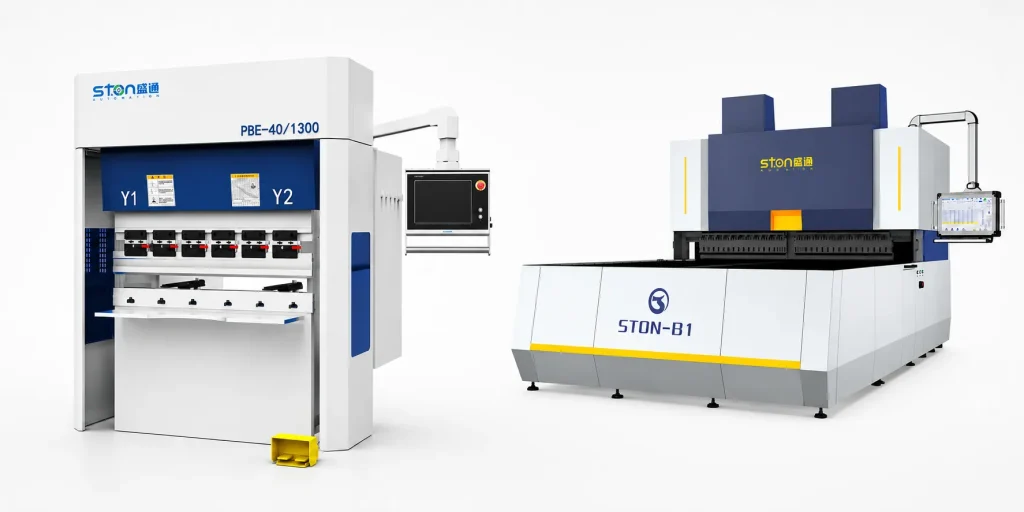
A panel bending machine holds the sheet under a blank holder and folds each edge with servo-driven upper and lower blades, which suits repeat runs of thin-gauge panels, doors and enclosures. A press brake drives a punch into a die, so it covers thicker plate, deep or irregular parts and frequent job changes.
Side-by-Side: STON Panel Bender vs STON Press Brake
Most comparison articles treat “panel bender” as one capability class. In practice the answer changes with the bed type, the material and the height of the box you are forming, so the table uses model-level data rather than category averages.
| Dimension |
STON CNC Panel Bender (Press Arm Type) |
STON PBS / PBE Press Brake |
| Forming principle |
Sheet clamped flat; folding blade swings up or down |
Punch presses sheet into a V-die |
| Max thickness at full bend |
Welded bed: CR 1.5 mm / SS 1.0 mm. Cast bed: CR 2.0 mm / SS 1.2 mm |
Set by tonnage class and die opening; request the bending chart for your material |
| Part size |
1000 × 1000 mm up to 2800 × 1500 mm |
Model codes run from 63/1500 to 320/4100 |
| Max bending (box) height |
170 / 300 / 400 mm options |
Limited by open height and cylinder stroke (215–315 mm on PBS) |
| Positive and negative bends |
Both, without flipping the part |
Part is flipped by operator or robot for direction changes |
| Control |
Imported all-electric servo closed-loop system with bus control; 15 servo axes on standard models |
DELEM 53T, 58T, 66T or 69T, or ESA (PBS); 4+1 axis pure electric (PBE) |
| Angle consistency along the bend |
Rapid compensation adjustment at each position on the bend line |
Mechanical deflection compensation (crowning) plus grating-ruler closed-loop feedback |
| Tooling |
Pressing and folding knives, optional upper/lower auxiliary knives, optional automatic tool change |
Punches and dies matched to each workpiece, quick-change clamps |
| Footprint (L × W × H) |
425 × 160 × 255 cm (A, welded) to 630 × 338 × 310 cm (D+, cast) |
2000 × 1620 × 2470 mm (63/1500) to 4760 × 2100 × 3250 mm (320/4100) |
| Automation |
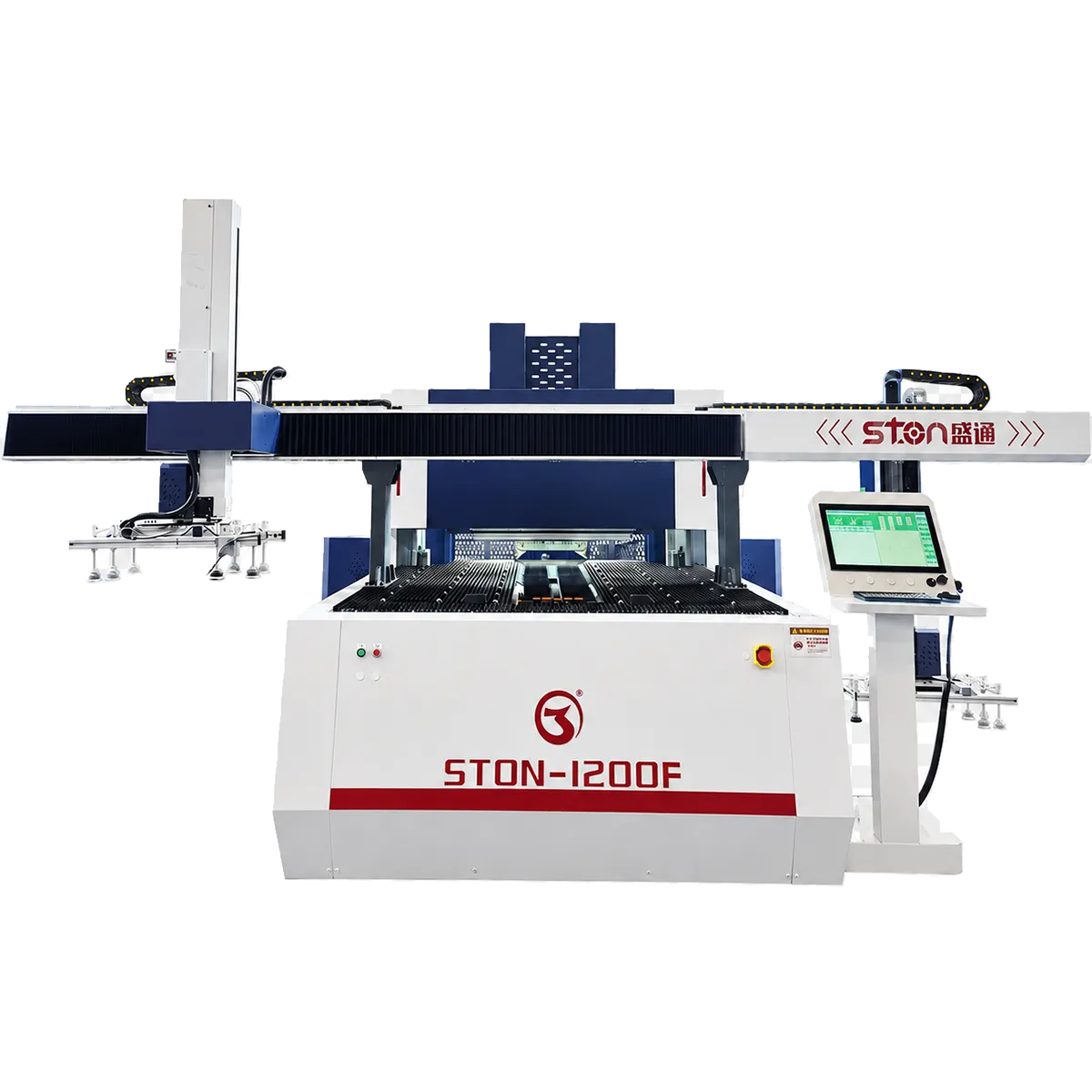
Native docking port for robotic arms and loading gantries |
Optional robot loading and unloading |
| Price |
On request, quoted after drawing review |
On request, quoted after drawing review |
How Each Machine Actually Forms the Bend
On a مكبح الثني, the sheet sits on the die and slides against the back gauge. The ram drives the punch down, and the bend angle comes from how deep the punch travels into the V-opening. Every flange in a different direction means the part comes off, turns over and goes back on. On a four-sided cabinet door with return flanges, that is a lot of handling per part, and the die shoulders touch the visible face of the sheet.
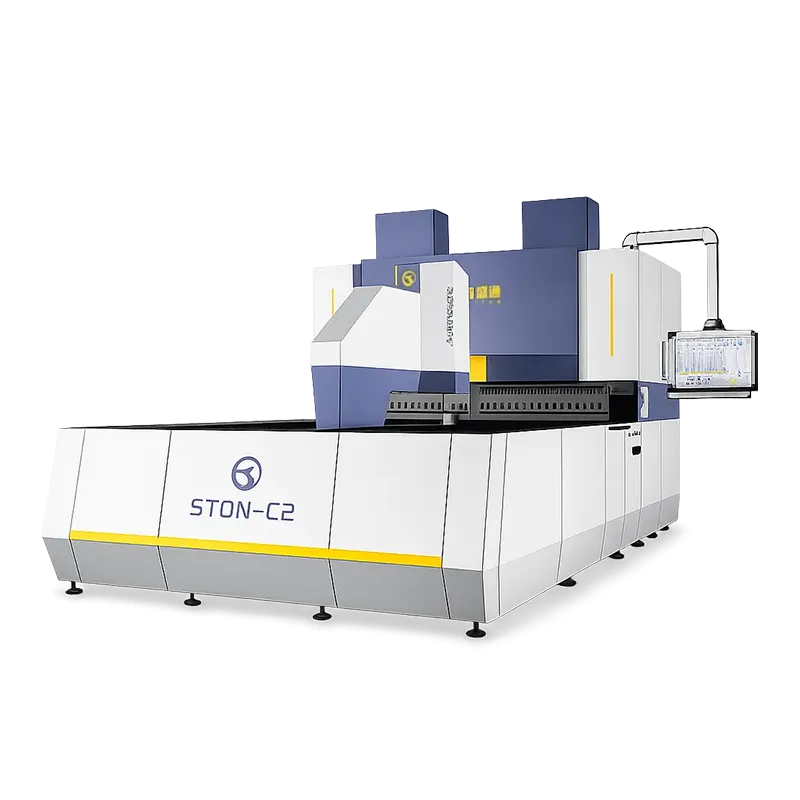
A panel bender works the other way round. The sheet lies flat on the table, the pressing knife clamps it along the bend line, and a folding blade moves up for a positive bend or down for a negative one. A manipulator rotates the sheet to present the next edge. The operator, or a robot, loads a flat blank and takes off a formed part.
That difference in motion explains most of what follows: why panel benders cap out at thinner gauges, why they handle closed box shapes well, and why press brakes still own long, thick and deep parts.
STON CNC Panel Bender Specifications (Press Arm Type)
Data from STON’s Press Arm Type spec sheet. Max bending height options are 170, 300 or 400 mm for every model; standard models carry 15 servo axes.
| Model |
Bed |
Max bending size (mm) |
Max thickness at full bend |
L × W × H (cm) |
| A (1000) |
Welded |
1000 × 1000 |
CR 1.5 / SS 1.0 mm |
425 × 160 × 255 |
| A+ (1200) |
Welded |
1200 × 1200 |
CR 1.5 / SS 1.0 mm |
430 × 180 × 255 |
| B (1400) |
Welded |
1400 × 1250 |
CR 1.5 / SS 1.0 mm |
540 × 198 × 298 |
| B (1400) |
Cast |
1400 × 1250 |
CR 2.0 / SS 1.2 mm |
450 × 206 × 290 |
| B+ (1600) |
Welded |
1600 × 1250 |
CR 1.5 / SS 1.0 mm |
560 × 218 × 290 |
| B+ (1600) |
Cast |
1600 × 1250 |
CR 2.0 / SS 1.2 mm |
462 × 226 × 290 |
| C (2000) |
Welded |
2000 × 1500 |
CR 1.5 / SS 1.0 mm |
596 × 258 × 298 |
| C (2000) |
Cast |
2000 × 1500 |
CR 2.0 / SS 1.2 mm |
558 × 270 × 310 |
| D (2500) |
Welded |
2500 × 1500 |
CR 1.5 / SS 1.0 mm |
596 × 308 × 298 |
| D (2500) |
Cast |
2500 × 1500 |
CR 2.0 / SS 1.2 mm |
615 × 308 × 310 |
| D+ (2800) |
Welded |
2800 × 1500 |
CR 1.5 / SS 1.0 mm |
626 × 338 × 298 |
| D+ (2800) |
Cast |
2800 × 1500 |
CR 2.0 / SS 1.2 mm |
630 × 338 × 310 |
Options that change what the machine can form
- Upper and lower auxiliary knives, with customizable length, for local small bends inside a larger edge.
- Thick plate reinforced model: a separate W-axis motor, or a three-motor drive on the W/X/Z axes, with a thicker machine body.
- C-axis lifting, magnetic grippers and custom clamping for workpieces that need lifting during the bend sequence.
- Automatic tool change for shops switching between part families during a shift.
- Custom pressing and folding knives designed from your drawings.
Electrical components are Schneider Electric, Airtac pneumatics and Inovance or Trio servo drives and motors. Lubrication lines are metal, so there is no plastic line to burst late in the machine’s life.
For smaller parts, STON also builds a suction cup (vacuum) type panel bender in the 1000–1600 size range. Its published common parameters are a minimum inner dimension of 140 × 190 mm for four-sided forming, a 5 mm minimum bending height, 0–180° bending angle, and angle accuracy of about ±0.5°/m with straightness of about 0.2 mm/m.
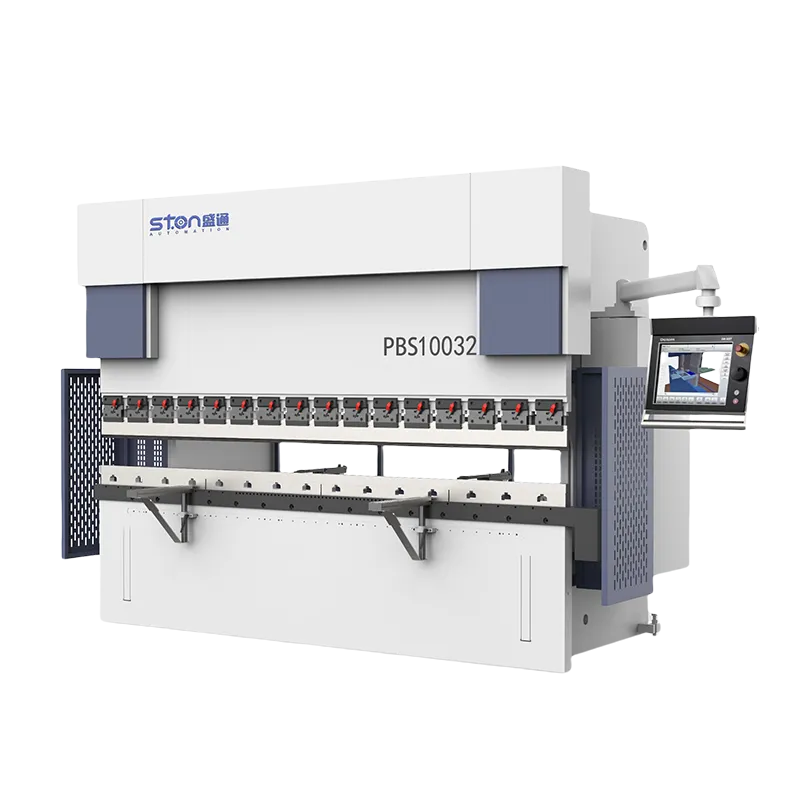
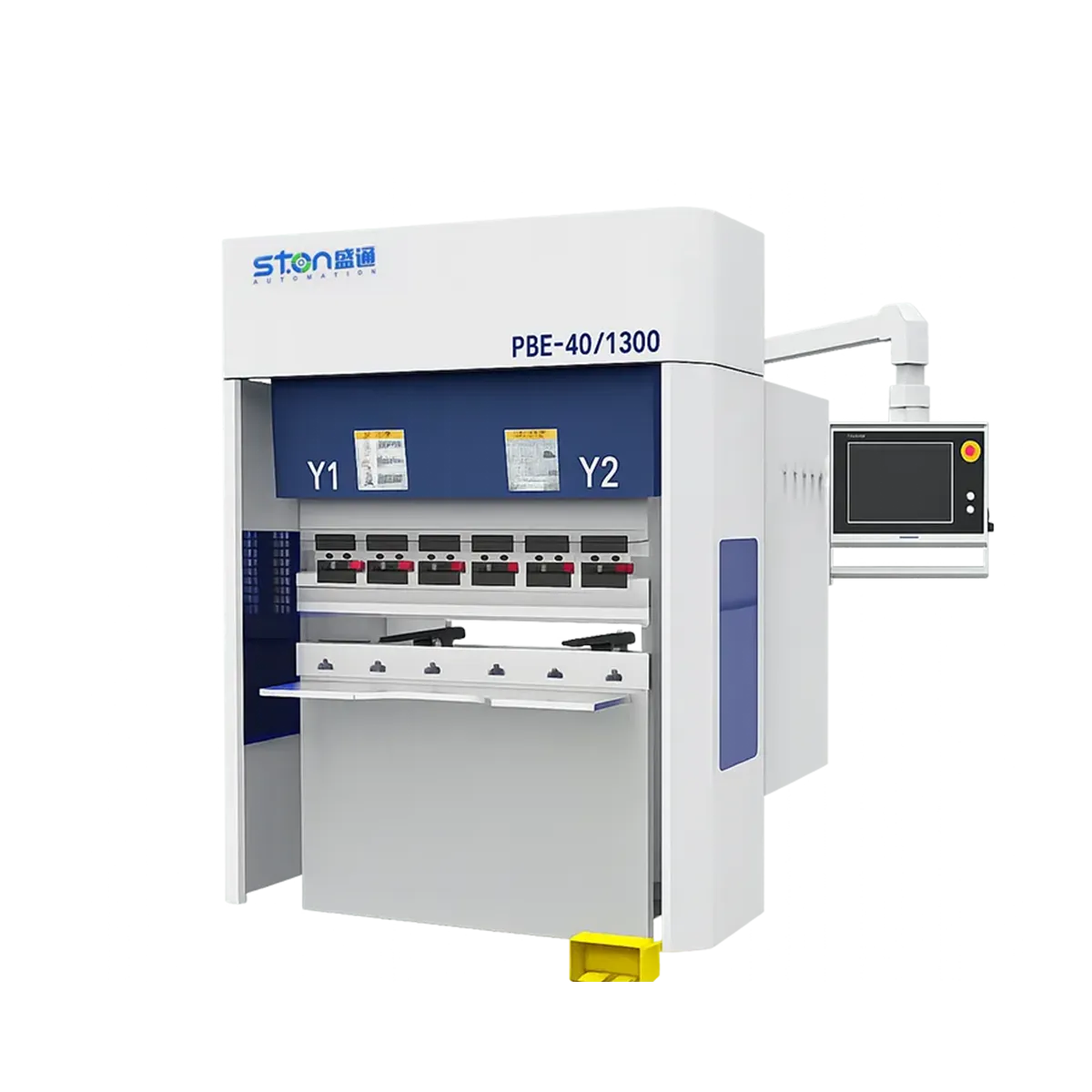
STON Press Brake Specifications: PBS and PBE
The PBS Series is the electro-hydraulic servo press brake. Selected models from the spec sheet:
| Model |
Main motor (kW) |
Cylinder stroke (mm) |
Hydraulic oil (L) |
Machine weight (kg) |
L / W / H (mm) |
| 63/1500 |
8.7 |
215 |
130 |
4,500 |
2000 / 1620 / 2470 |
| 63/2550 |
8.7 |
215 |
200 |
6,000 |
3150 / 1620 / 2470 |
| 100/3200 |
10.8 |
215 |
300 |
8,500 |
3720 / 1720 / 2550 |
| 150/4100 |
13.2 |
215 |
400 |
11,600 |
4680 / 1730 / 2600 |
| 220/4100 |
16.7 |
215 |
400 |
13,200 |
4730 / 1800 / 2670 |
| 320/4100 |
22 |
315 |
500 |
19,000 |
4760 / 2100 / 3250 |
PBS machines use a welded high-strength frame with annealing, shot blasting and aging, a mechanical compensation system against slide and table deflection, a grating ruler for closed-loop positioning, a multi-axis CNC back gauge, ESTUN servo drive with ESTUN and Siemens electrics, and a laser protection device that stops the machine when a person or object enters the guarded zone.
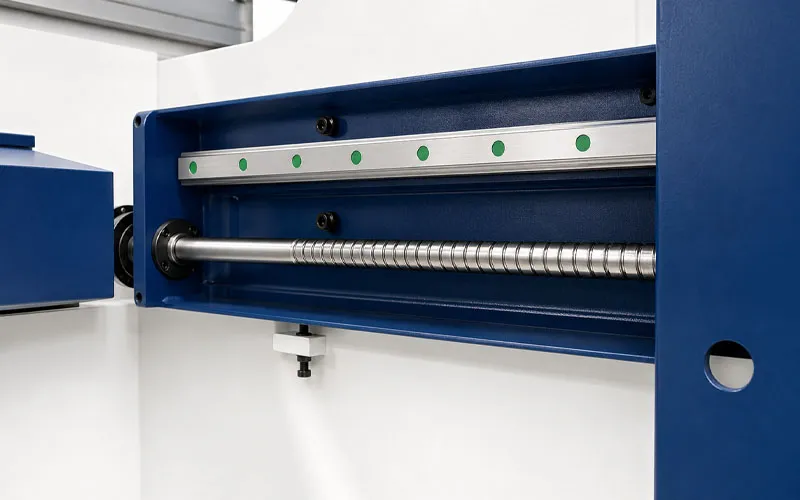
The PBE Series is the 4+1 axis pure electric press brake. It replaces the hydraulic system with a direct-drive servo motor, heavy-duty ground lead screws and linear guides, so there is no hydraulic oil to change or leak. Model-by-model PBE parameters are supplied with the quotation.
Choosing Between Them in Six Steps
- List your top 20 parts by annual volume. Use real drawings, not product categories.
- Sort by material and thickness. Flag anything above CR 2.0 mm or SS 1.2 mm as press brake work.
- Check size and height. Blank length over 2800 mm, or a formed height above 400 mm, rules out this panel bender series.
- Count bends and direction changes per part. Parts with four or more flanges and both positive and negative bends favor the panel bender.
- Estimate changeovers per shift. Frequent changes inside one product family favor the panel bender; changes between unrelated jobs favor the press brake.
- Request sample validation. Send drawings, material and target output so the configuration (bed type, height option, auxiliary knives, automation) is checked against real parts before you order.
Many plants end up with both: a panel bender for the high-volume enclosure family and a press brake for thick, long and one-off work.
الأسئلة الشائعة
Can a panel bender replace a press brake completely?
Rarely. It replaces press brake work on thin-gauge boxes and panels within its thickness, size and height ratings. Parts above CR 2.0 mm or SS 1.2 mm, longer than 2800 mm, or taller than 400 mm still need a press brake on STON’s press arm series.
What thickness can a STON panel bender bend?
At full bend, welded-bed models are rated CR 1.5 mm and SS 1.0 mm. Cast-bed models (1400 size and up) are rated CR 2.0 mm and SS 1.2 mm. The thick plate reinforced model adds motor power on the W/X/Z axes for heavier work.
Is a panel bender more accurate than a press brake?
A: It is more consistent from part to part because the operator does not position each bend. A press brake with a grating ruler and crowning can hold tight angles, but results depend more on the operator, the blank and the tooling.
Which machine suits electrical cabinets and steel doors?
Panel benders are the usual choice for cabinet panels, doors and drawers with flanges on several sides, provided thickness and height sit within the rating. Heavy frames and long profiles stay on the press brake.
Electro-hydraulic or pure electric press brake?
The PBS electro-hydraulic series covers tonnage classes up to the 320 models and bending lengths to 4100 mm. The PBE pure electric series uses a direct-drive servo with no hydraulic oil, which simplifies maintenance. Choose by tonnage need, then by maintenance preference.
Can both machines be automated?
Yes. STON panel benders have a native docking port for robotic arms and loading gantries, and both PBS and PBE press brakes can be expanded with robotic loading and unloading.



 October 28, 2026