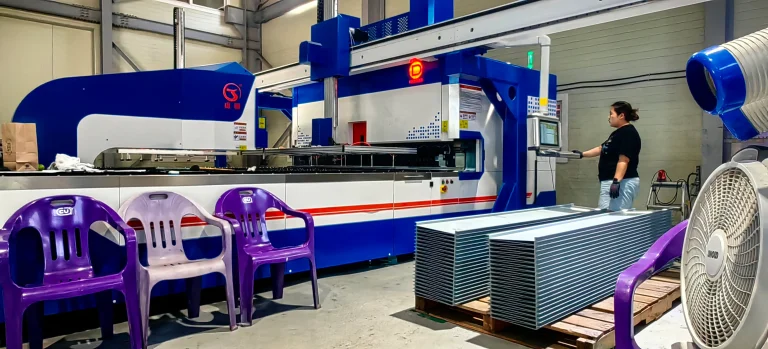
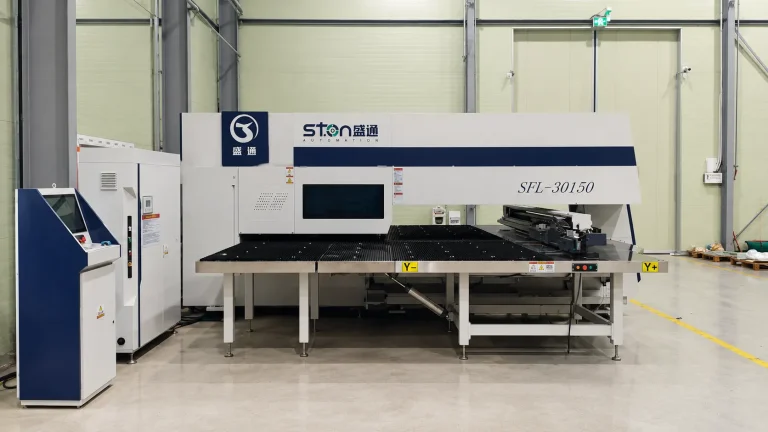
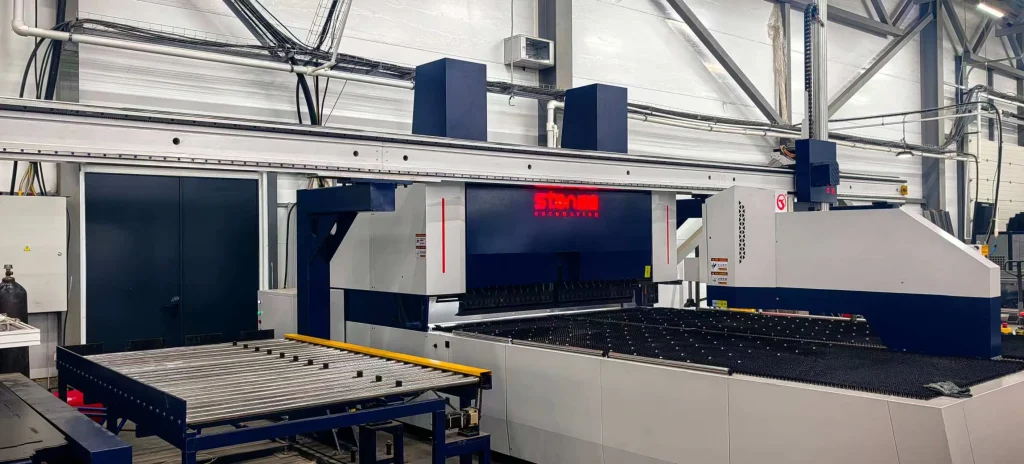
A fire door manufacturer in Russia selected a STON Panel Bender with Loading and Unloading Robot for its sheet metal bending operations.
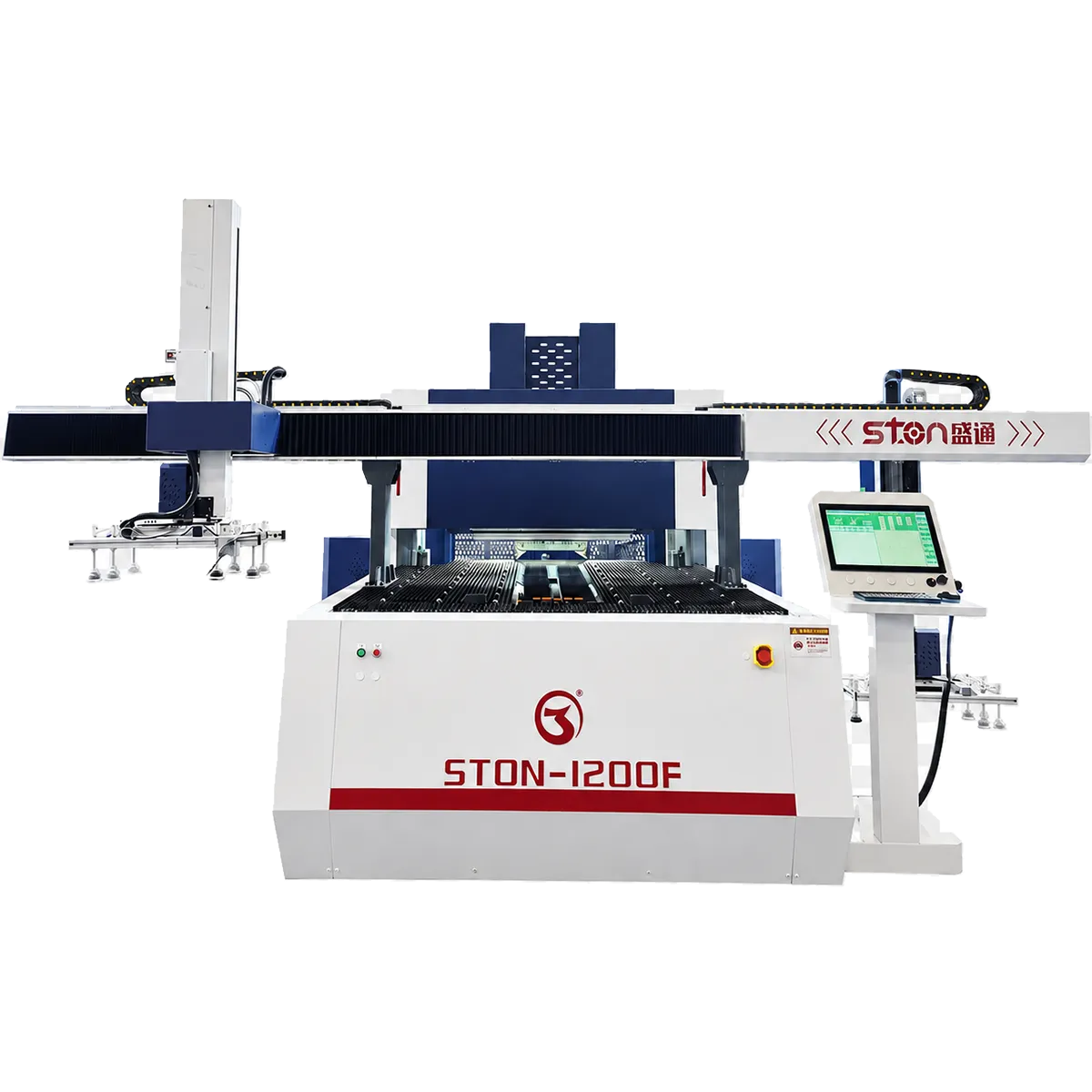
The equipment combines CNC panel bending with automated material handling. The panel bender performs programmed multi-edge bending, while the loading and unloading robot supports sheet pickup, positioning, transfer and removal of processed panels.
Country: Rússia
Industry: Fire Door Manufacturing
Equipment: Panel Bender with Loading and Unloading Robot
Main Process: Automated sheet metal panel bending
Automation Scope: Loading, positioning, bending, unloading and transfer
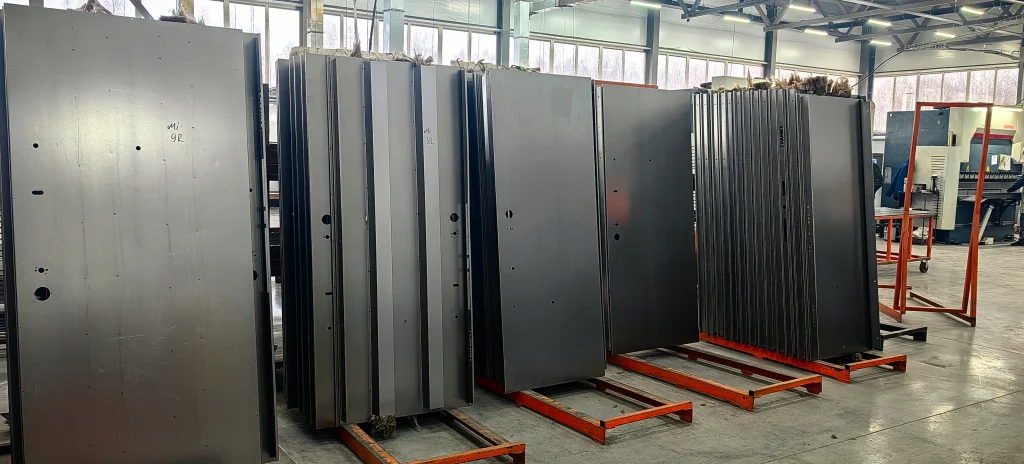
Workpiece Type: Sheet metal components for fire doors
Fire Door Panel Bending Requirements
Fire door production involves sheet metal components with long edges and multi-step profiles. According to STON’s door-industry information, security and fire door components may require processes such as:
- Straight-edge bending
- Return flange forming
- Multi-angle bending
- Offset bending
- Dead-edge folding
- Formation of sealing profiles
These profiles must be produced consistently so that the processed panels can proceed to subsequent door manufacturing and assembly operations.
Conventional bending methods can require repeated manual positioning, workpiece rotation and multiple bending setups. For larger panels, repeated manual handling also adds work between individual bending cycles.
For this Russian project, the selected configuration combines a dobradeira de painéis CNC with a loading and unloading robot to connect material handling and bending in one automated cell.
A solução da STON
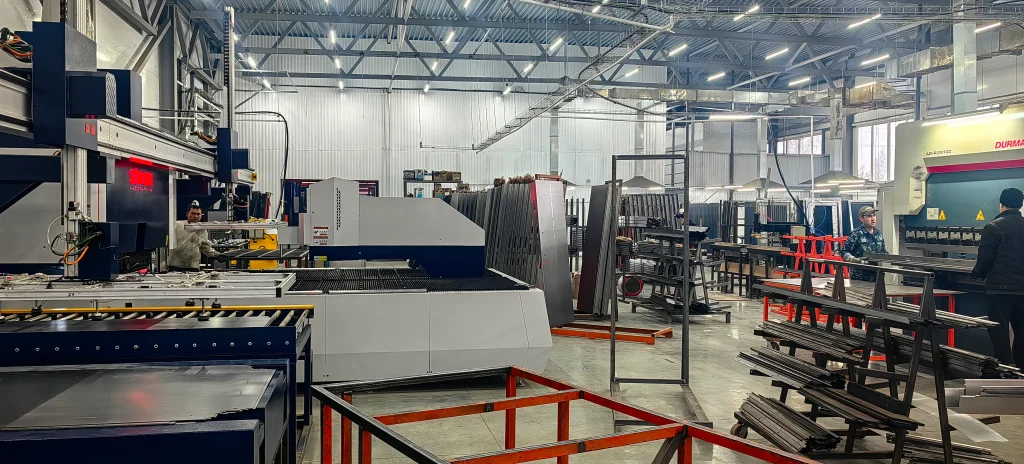
STON supplied a Panel Bender with Loading and Unloading Robot for the fire door manufacturing application.
The solution is designed around two coordinated systems:
- A CNC panel bender for programmed sheet metal bending
- A robot for automatic loading, unloading and workpiece transfer
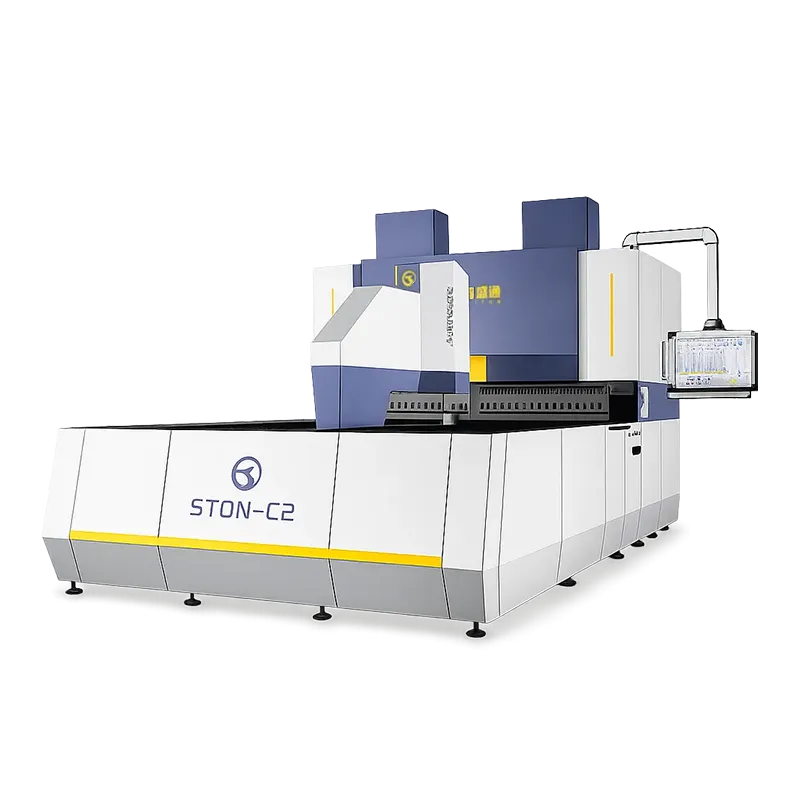
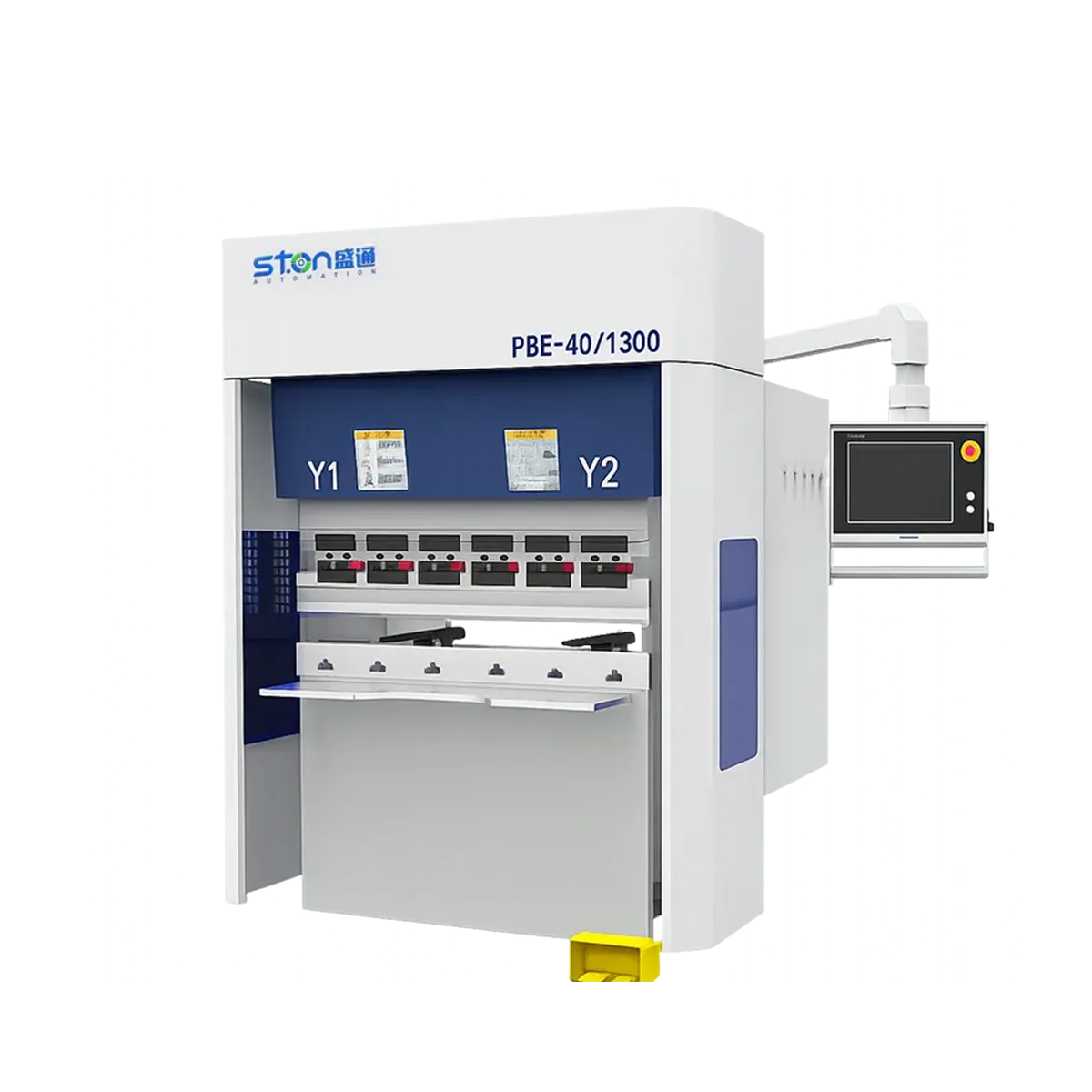
STON panel benders are designed to perform positive and negative bends and handle multi-angle panel profiles through programmed CNC operation. According to the published product range, STON press-arm panel benders are available with maximum bending lengths from 1,000 mm to 4,100 mm, depending on the selected model and configuration.
Published material limits for the panel bender range include:
| Material |
Published Maximum Thickness |
| Stainless steel |
1,2 mm |
| Cold-rolled steel |
2,0 mm |
| Aluminum |
2,5 mm |
The exact model, bending length, sheet thickness and robot payload used in the Russian project have not been publicly disclosed and should therefore be confirmed from the final project specification.
Automated Loading and Unloading
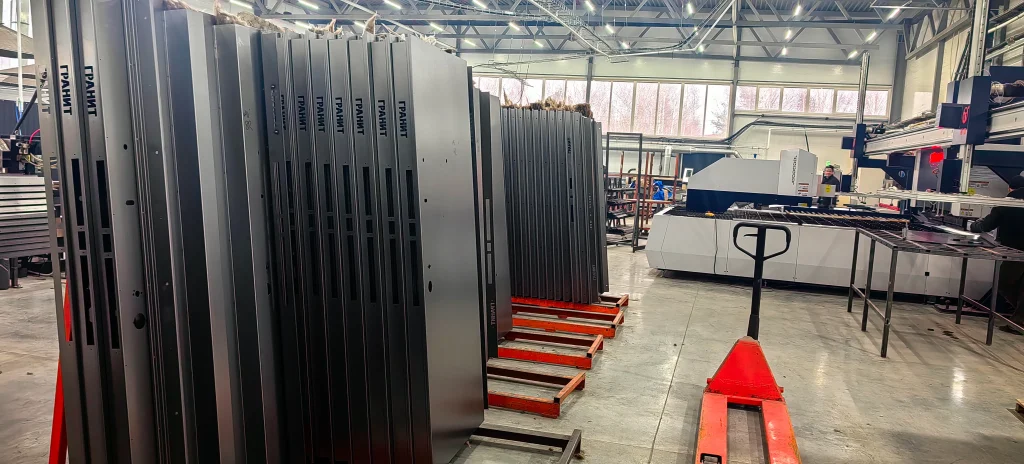
The robot supports the movement of sheet metal components around the bending station. Depending on the final project layout and gripper configuration, STON’s automatic loading and unloading systems can be designed to perform:
- Sheet pickup from the loading position
- Transfer to the panel bender
- Workpiece positioning
- Coordination with the bending cycle
- Removal of the processed panel
- Transfer to an unloading or stacking position
STON offers vacuum suction cups and magnetic gripping options according to the sheet material, dimensions and weight. Robotic handling is particularly suitable when flexible movement or multi-position transfer is required.
For this fire door application, integrating the robot with the panel bender reduces the need to repeatedly lift, move and reposition door components manually. It also creates a more coordinated workflow between loading, bending and unloading.
CNC Panel Bending for Fire Door Components
STON identifies CNC panel benders as recommended equipment for metal door manufacturing. The machine can process multi-angle door panel profiles through a programmed bending sequence.
Relevant panel-bending capabilities include:
Multi-edge bending
The CNC system controls the bending sequence for different edges of the workpiece. This is suitable for door components that require several bends around the perimeter.
Dobra positiva e negativa
The panel bender can perform positive and negative bends without requiring the same manual repositioning associated with conventional multi-step bending.
Programmed positioning
Once a suitable bending program has been created, the equipment controls the bending process according to the defined workpiece profile.
Automated handling interface
STON panel benders can be integrated with robotic, gantry or truss-type loading and unloading systems. This allows the bending equipment to operate as part of an automated production cell rather than as an isolated machine.
Material compatibility
The published panel bender range supports stainless steel, cold-rolled steel and aluminum within the thickness limits of the selected machine.
Equipment Configuration
The confirmed project configuration consists of:
- STON CNC panel bender
- Loading and unloading robot
- CNC bending control
- Automated workpiece transfer
- Machine-to-robot operating coordination
Additional details such as the panel bender model, robot brand, gripper type, bending length, workpiece dimensions and production cycle were not included in the supplied project information. They are therefore intentionally not stated in this case study.
Application Value
The configuration is intended to support a more automated fire door panel bending workflow.
Based on the published functions of the STON equipment, the system can provide the following operational advantages:
- Reduced repeated manual lifting and workpiece movement
- Automated transfer between loading, bending and unloading positions
- Programmed execution of multi-edge bending sequences
- More consistent handling of repeated panel designs
- Reduced waiting time between material handling and bending
- Lower risk of scratches caused by unnecessary dragging or repeated manual contact
- A foundation for integration with other sheet metal processing stages
Sobre a STON
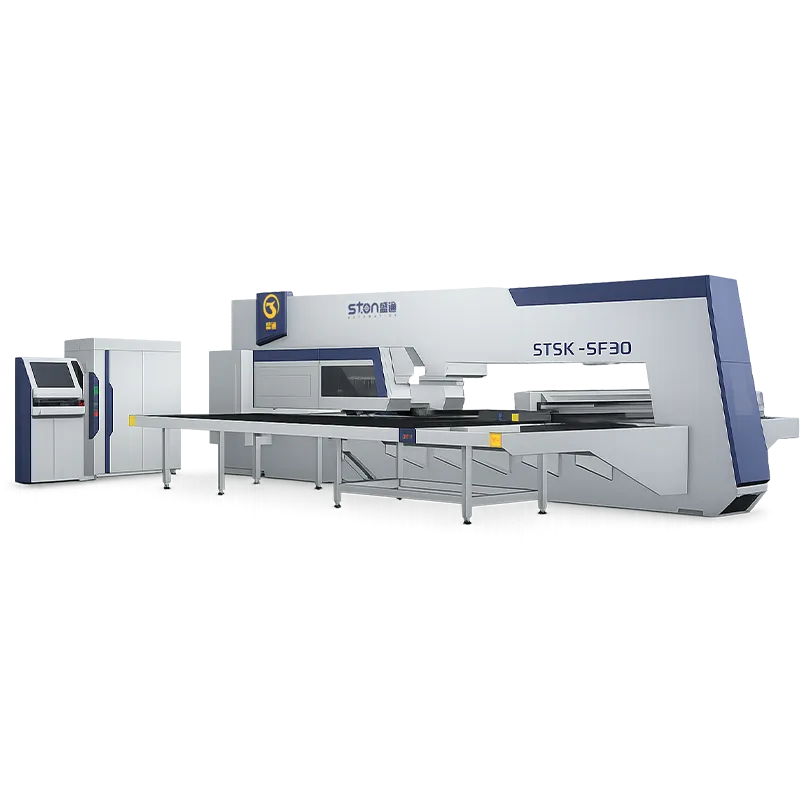
STON is a CNC sheet metal equipment manufacturer established in 2006. Its product portfolio includes CNC panel benders, turret punch presses, press brakes, fiber laser cutting machines, laser-punch combination machines, flexible edge bending machines, automatic loading and unloading systems, and customized sheet metal production lines.
STON manufactures and assembles its equipment at its self-owned facility in Qingdao, China. The company provides standard machines as well as customized automation configurations based on sheet dimensions, material thickness, workpiece flow and factory layout.
Conclusão
This Russian fire door project uses a STON Panel Bender with Loading and Unloading Robot to combine automated workpiece handling with CNC panel bending.
The panel bender processes programmed multi-edge profiles, while the robot supports loading, positioning, unloading and transfer. The resulting configuration is designed for the sheet metal bending requirements of fire door manufacturing and provides a basis for a more coordinated and automated production workflow.



 June 02, 2026