An eight-step checklist for vetting a CNC press brake manufacturer in 2026: in-house casting vs assembly, axis count, crowning method, EN ISO 16092 compliance, tooling and service terms.
Vetting a CNC press brake manufacturer comes down to eight verifiable checks: who casts and machines the frame, how many controlled axes come standard, how crowning is achieved, which safety standard the machine is certified to, and how fast a service engineer reaches your floor. Everything else is marketing.
Step 1: Establish what the supplier actually makes
Ask one question before any technical discussion: which of these operations happen inside your own building — casting or plate welding, stress relief, structural machining, assembly, final inspection?
Many companies selling under their own brand buy welded or cast frames from a third party, machine nothing, and assemble bought-in cylinders, controls and drives. That is a legitimate business model and it can produce a serviceable machine. It changes what you can expect when something goes wrong three years later.
| Vetting Dimension |
Full In-House Manufacturer |
Assembly-Only Supplier |
| Frame Origin |
Cast or welded and stress-relieved under its own process control |
Purchased; process records are held by a subcontractor |
| Structural Machining |
Own gantry or floor-type machining with internal tolerance records |
Outsourced; tolerances are inherited |
| Traceability of a Precision Fault |
One party owns the frame, machining, and assembly data |
Responsibility is divided among two or three companies |
| Non-Standard Tonnage / Length |
Engineering changes are made using its own drawings |
Requires approval from the frame supplier |
| Spare Structural Parts After 5 Years |
Produced to the original drawings upon request |
Depends on whether the subcontractor is still operating |
| Who Signs the Accuracy Claim |
The manufacturer |
The assembler, based on another supplier’s steel structure |
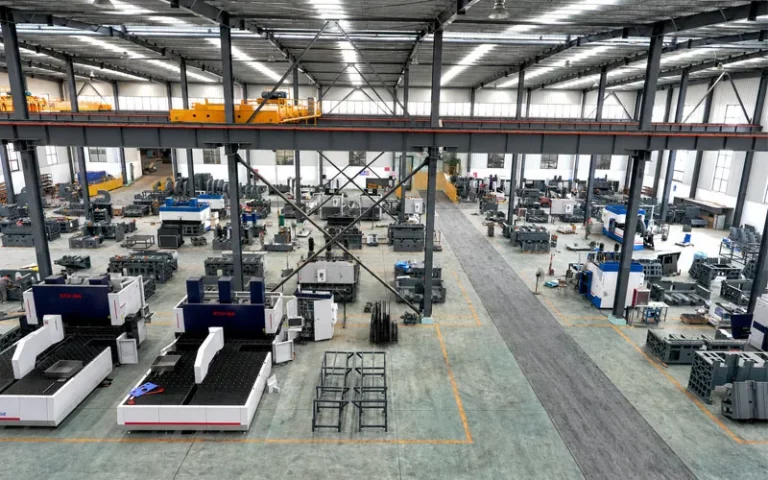
STON runs the full chain in its own 20,000 ㎡ plant, from casting and heat treatment through machining, assembly and final inspection, with a published assembly accuracy of ±0.05 mm.
Step 2: Read the structural numbers, not the tonnage badge
Two 100-ton machines with the same bending length can differ by two tonnes of steel. The specification lines that carry that information are plate thickness (vertical plate / ram / worktable) and machine weight.
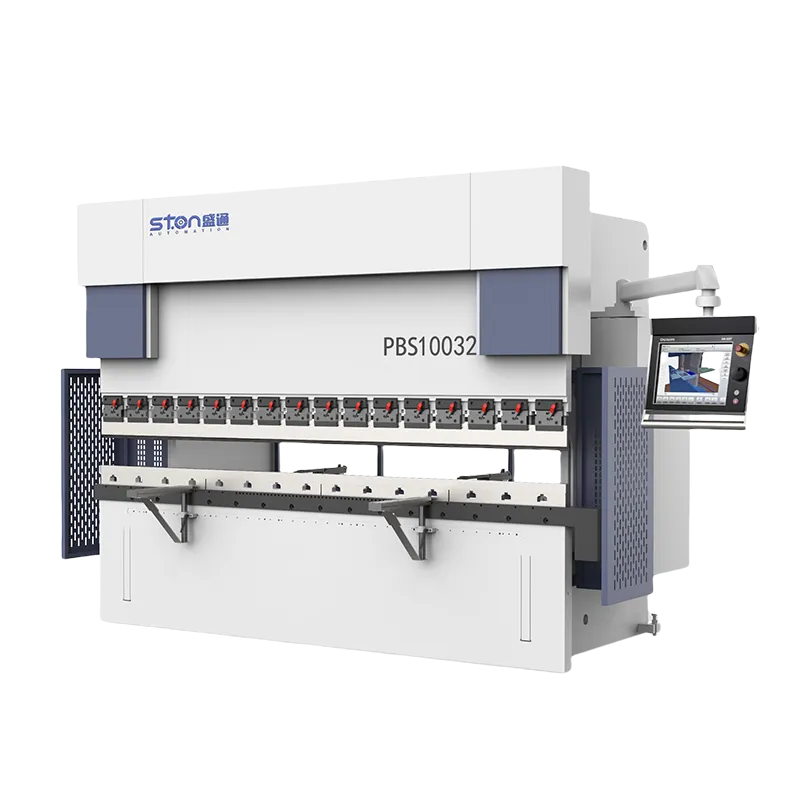
From STON’s electro-hydraulic press brake data sheet, plate thickness runs 40/50/60 mm on the 63-ton frames and 80/100/120 mm on the 320-ton frames, with machine weight climbing from 4,500 kg at 63/1500 to 19,000 kg at 320/4100. Ask any shortlisted supplier for the same two lines. If they are absent from the brochure and the sales engineer cannot retrieve them, that tells you something about how the machine was specified.
A second structural question: what treatment did the weldment receive? STON’s frames are welded from high-strength plate and then annealed, shot-blasted and aged to release internal stress. Skipping ageing does not show up at acceptance. It shows up as angle drift after eighteen months of production.
Step 3: Count the axes, and separate standard from optional
“5-axis” on a quotation can mean Y1, Y2, X, R, Z1 on one machine and Y1, Y2, X, R, plus crowning counted as an axis on another. Write the axis list into the purchase order by name.
The functional questions behind the number:
1.Does the back gauge move in X (depth) and R (height) under CNC, or is R adjusted by hand?
2.Are Z1/Z2 finger positions programmable, and do you actually need them for your part mix?
3.Is crowning a controlled axis or a manual wedge setting?
4.How many bend steps can one program hold, and can the operator recall a stored job in one action?
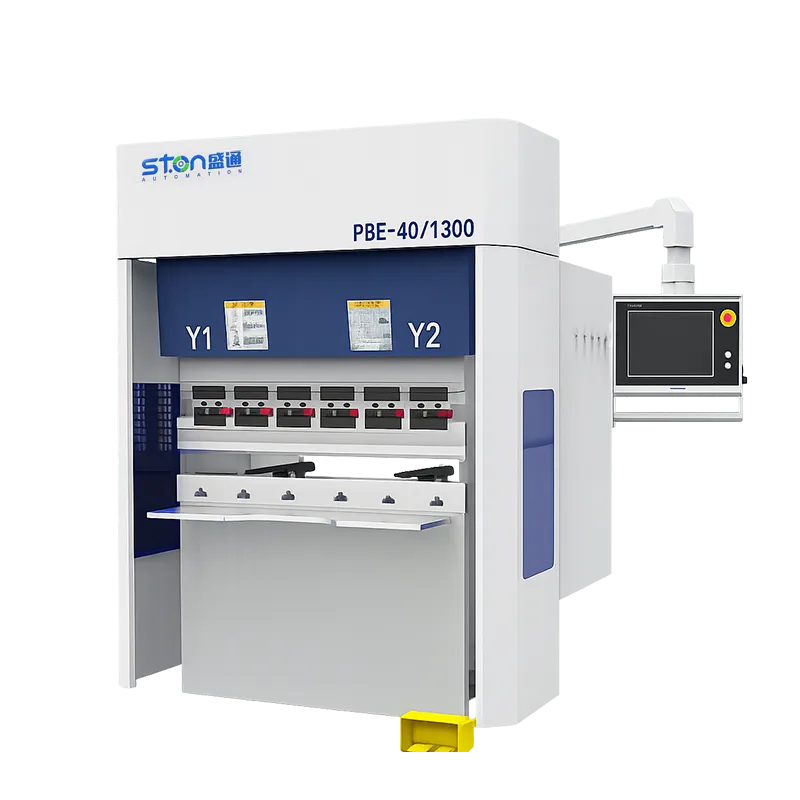
STON‘s press brakes use a multi-axis CNC back gauge with continuous positioning across multi-segment bends, which is the configuration that matters if your parts have four or more bends in sequence. If your work is two-bend brackets in long runs, paying for Z-axis fingers buys you nothing.
Step 4: Ask how the machine compensates for deflection
Under load, the ram and the table bow apart at the centre. Every press brake does this. What differs is the correction.
Shim-based correction means a set-up person adds packing under the die and re-tests until the angle is even along the length. It works. It costs twenty minutes to an hour on every job change and depends on who is on shift.
Mechanical wedge crowning corrects the deflection through a wedge system built into the table, adjustable from the control. STON’s press brakes ship with mechanical deflection compensation as standard, working together with a grating scale in a closed loop for ram position feedback. For a shop running six or more job changes a day, this is usually the line item with the shortest payback in the whole quotation.
The common mistake: buyers compare crowning as a yes/no feature. Ask instead how it is adjusted, how long the adjustment takes after a workpiece change, and whether the value is stored with the part program.
Step 5: Fix the control, and find out who supports it
STON offers DELEM 53T, 58T, 66T and 69T controls, with an Italian ESA system available as an option, and stores multiple process parameter sets for one-click recall. That range exists because the right control depends on who runs the machine.
Three things to settle before signing:
- Whether the control is a mainstream brand your local technicians already know, or proprietary firmware only the factory can reflash
- Which language the interface and the operator manual are supplied in
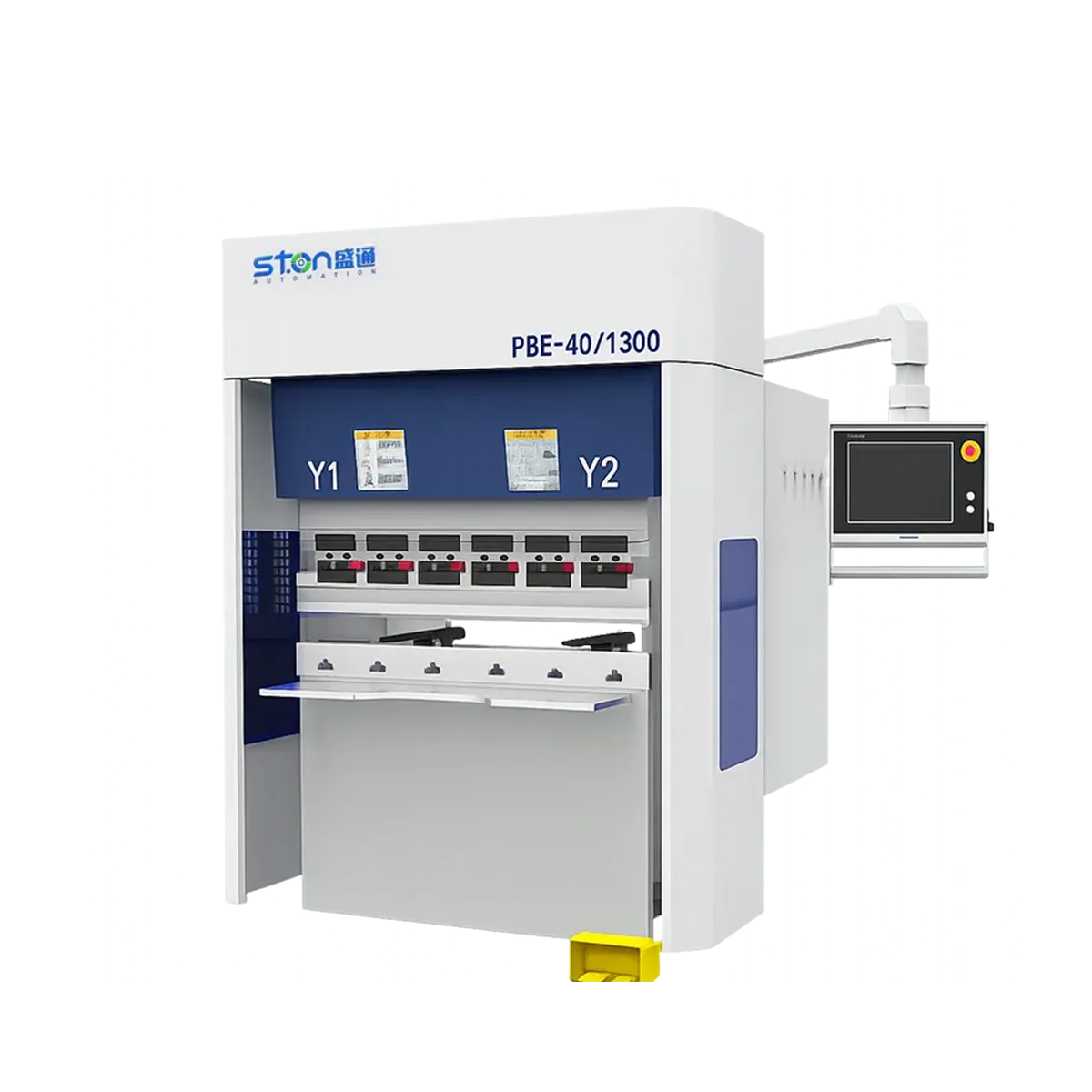
- Whether the drives and electrical components are named in the contract — STON specifies ESTUN and Siemens components on the electro-hydraulic series, and a direct-drive servo motor on the pure-electric PBE series
Dealers should press hardest on the first point. A proprietary control turns every software fault into an international support ticket.
Step 6: Check the certificate against the correct standard
CE marking is a declaration, not an inspection. For press brakes, the standards that carry the technical content are EN ISO 16092 (safety of presses) and EN 12622 (hydraulic press brakes), sitting on the general framework of EN ISO 12100 for risk assessment and EN ISO 13849-1 for the performance level of safety-related control functions.
What to request, in this order:
- The Declaration of Conformity naming the model and serial number, not a generic company certificate
- The harmonised standards listed on that declaration
- The performance level (PL) claimed for the guarding and the stop function under EN ISO 13849-1
- The technical file reference and the notified body involved, where third-party involvement applies
- The ISO 9001 certificate of the manufacturing site, with scope and expiry visible
STON‘s machines are supplied with laser guarding that halts the ram when the protected zone is broken, and the company holds ISO and CE certification. The point of the list above is that you should be reading those documents yourself rather than accepting the logo on a brochure.
Step 7: Settle tooling and clamping before price
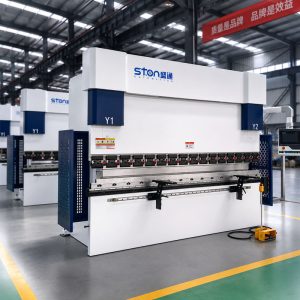
Tooling decides changeover time, and changeover time decides whether the machine hits the output you costed it at. STON supplies dies matched to the customer’s parts and uses quick-change clamping that accepts different die specifications, which is the arrangement to look for. Confirm which standard the tool shanks follow, how many die sets are included in the quoted price, and what a replacement set costs and how long it takes to arrive.
Step 8: Put the service terms in the contract
STON publishes a 48-hour on-site response commitment across 80+ countries, with lifetime tracking, software updates and a dedicated spare-parts warehouse. Any supplier can publish a number. Convert it into contractual language:
- Response time measured from what event, and during which hours
- Which parts are held in stock in or near your region, and which ship from the factory
- Who pays the engineer’s travel, in warranty and out of warranty
- How many operator and maintenance training days are included, and where they take place
- Whether remote diagnostics require the machine to be networked, and who owns that data
FAQ
Q: Is a cast frame better than a welded frame on a press brake?
A: Not automatically. What matters is stress relief. STON’s press brake frames are welded from high-strength plate and then annealed, shot-blasted and aged; on the panel bender line, both cast iron and welded beds are offered, and both are annealed. Ask for the treatment record rather than the material name.
Q: How many axes does a press brake actually need?
A: For simple two-bend parts, Y1/Y2 plus X and R covers the work. Z1/Z2 finger positioning earns its cost when parts have varied flange geometry and four or more bends. Buy the axis count your part drawings justify, not the one on the competitor’s brochure.
Q: Does CE marking mean the machine passed a safety inspection?
A: No. CE marking is the manufacturer’s declaration of conformity. The substance sits in the harmonised standards behind it, principally EN ISO 16092 and EN 12622 for press brakes, with EN ISO 13849-1 covering the safety control functions. Request the model-specific declaration and the standards it names.
Q: What is the difference between electro-hydraulic servo and pure electric press brakes?
A: The electro-hydraulic servo machine uses a servo-controlled pump, giving high tonnage across the range up to 320 tons in STON’s series. The pure-electric PBE series uses direct servo drive, eliminating hydraulic oil and its maintenance and contamination issues, and generally suits lighter-gauge, high-cycle work.
Q: How do I check whether a supplier really manufactures in-house?
A: Ask for a live video walk of the machining bay showing a frame of your model on the table, plus the heat-treatment record for a frame currently in production. Photographs and drone footage of a building prove nothing about who owns the process.
Q: How long should a press brake lead time be?
A: It depends on configuration and the factory’s slot availability, which is why the useful question is not “how long” but “which production slot number, and what are the stage dates”. A supplier who manufactures can give you both.



 August 06, 2026