Steel Door Production

Оборудование с ЧПУ для линий производства стальных дверей

A steel door is two skins, a frame and a set of edge profiles that all have to meet each other. Get the bend angle wrong by a fraction over a 2,100 mm leaf and the door binds, the seal gaps, and the problem is found at the hanging stage — after every other operation has already been paid for.

STON builds the punching, bending and edge-forming equipment behind steel door, fire door and security door production, from single machines to fully automated lines. Door manufacturers in Turkey, Kazakhstan, Russia and Mexico run these machines today — the projects are documented further down this page.

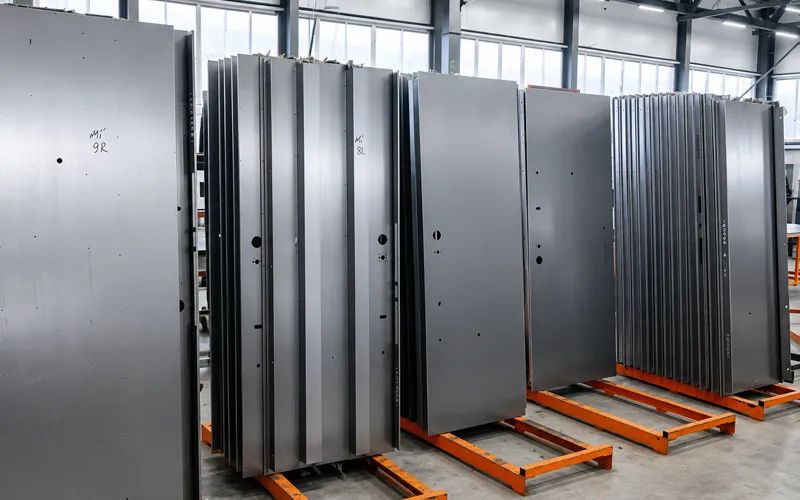
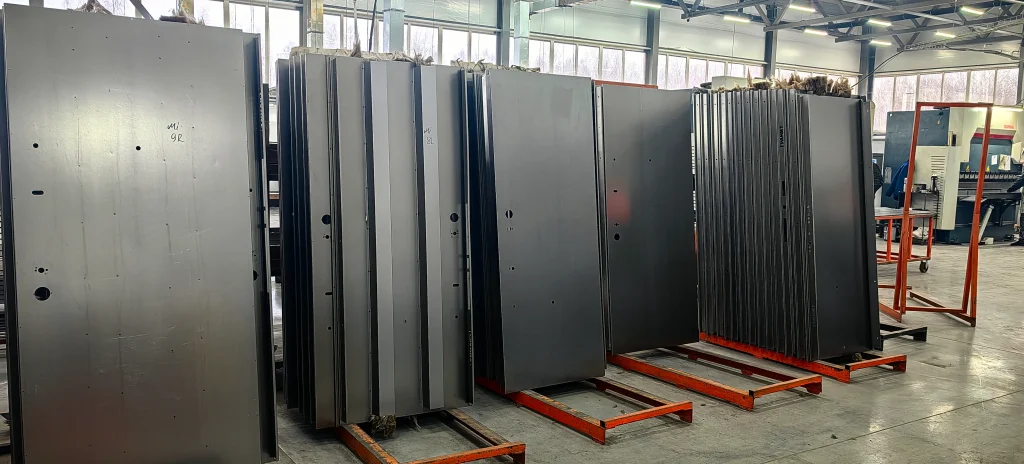
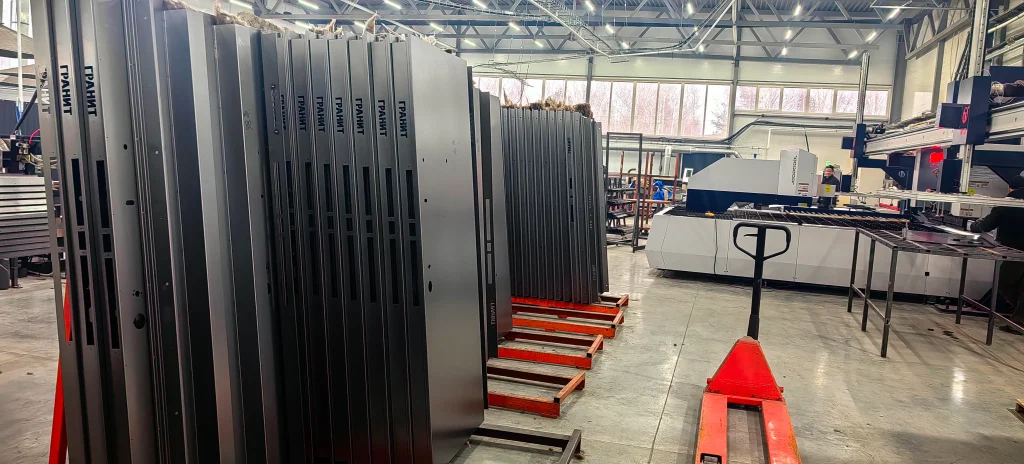
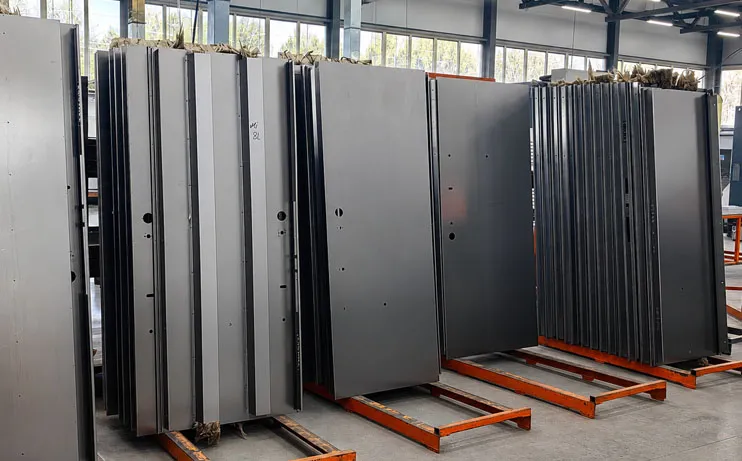
Formed steel door panels stacked on racks in a door production plant
Formed door panels off a STON line. Consistency across a batch is what decides whether they hang without adjustment.
Scope

What equipment does a steel door plant actually need?

Door plants buy machines by part, not by product. The leaf, the frame and the hardware cut-outs pull in three different directions, and the honest answer is that no single machine covers all three well.

DOOR PART WHAT IT DEMANDS MACHINE Door leaf / skin up to ~2,400 mm, 0.6–1.2 mm galvanised One angle along the whole length, hems and return flanges in one pass листогибочный пресс or Flexible Edge Bender Frame / jamb profile 1.2–2.0 mm, long, many bends Tonnage, long-bed accuracy and deflection control over length Листогибочный пресс с ЧПУ tandem for extra-long frames Lock, hinge, vision cut-outs repeated position-critical features Every hole in one setup, so lock and hinge never disagree CNC Turret Punch 32 stations, ±0.1 mm Louvre & screen panel dense repeated perforation Hundreds of identical features faster than a beam can trace them CNC Turret Punch laser only for odd contours Two forming machines, not one. A leaf and a frame want different things from a bender. Door plants that try to do both on one machine end up compromising the part they make most of.
Door parts and the machine each one calls for. The usual STON door line is a turret punch in front, a panel bender for leaves, a press brake for frames.
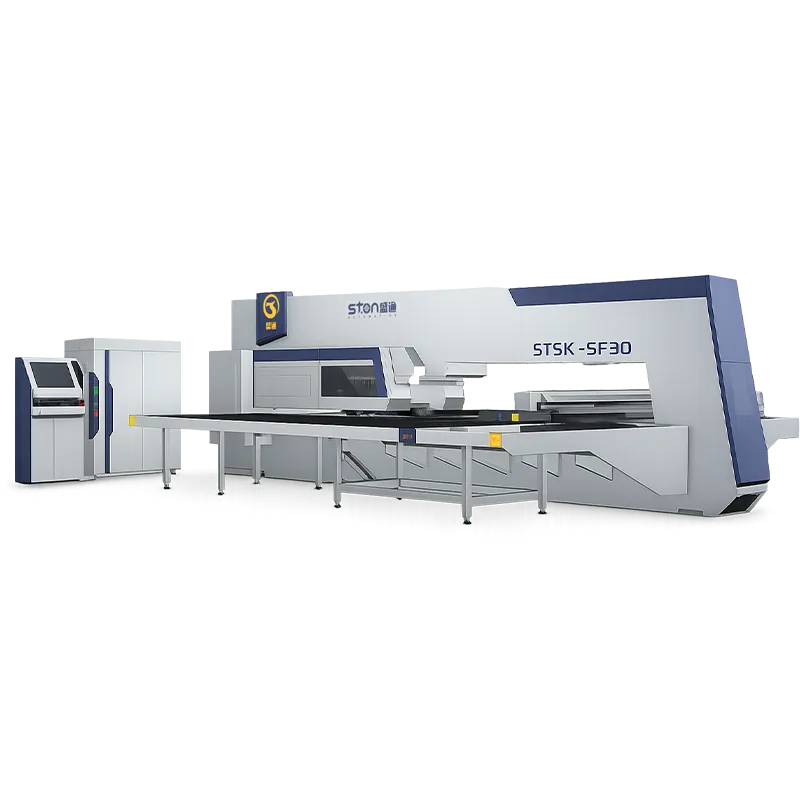
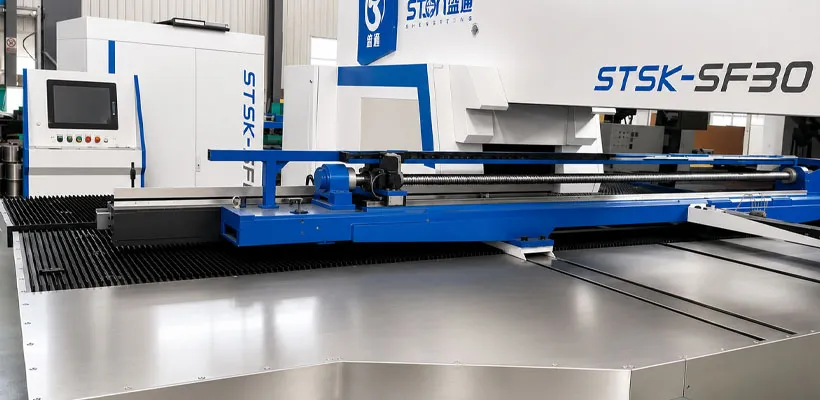
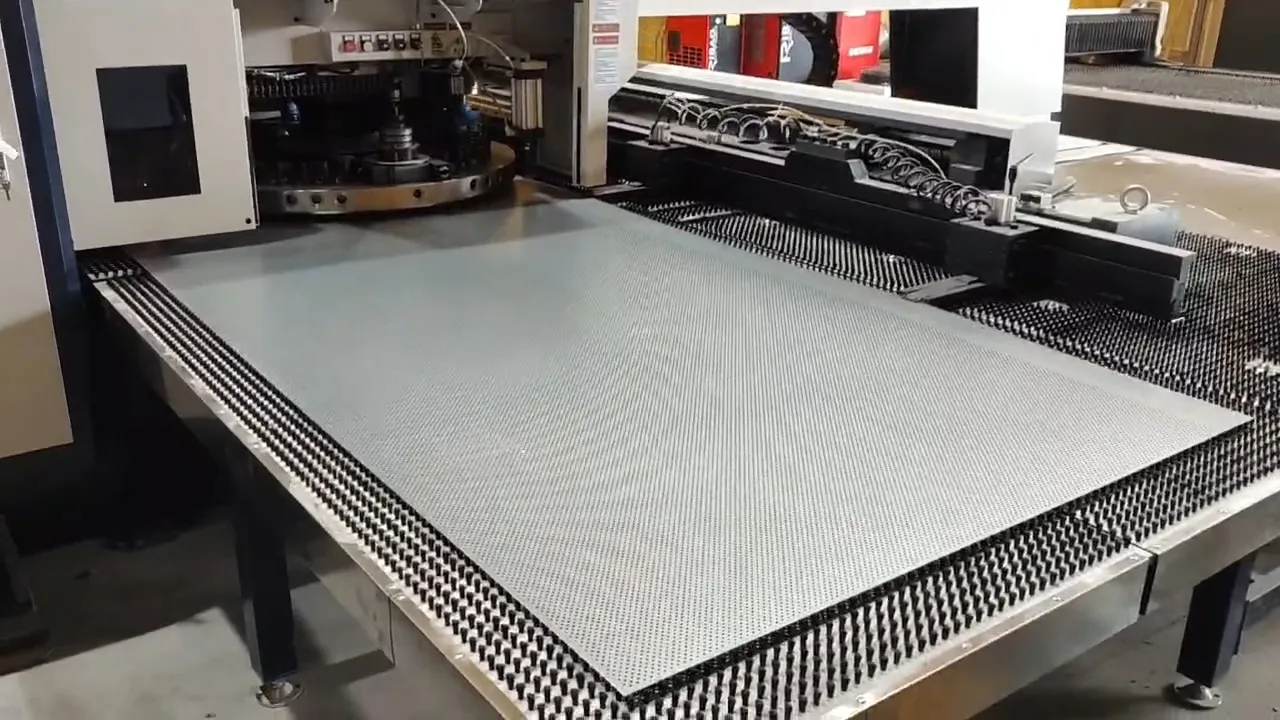
STON STSK-SF30 CNC turret punching machine blanking a full-size steel door sheet
Blanking. Lock, hinge and vision cut-outs punched in a single setup, so their relative positions cannot drift.
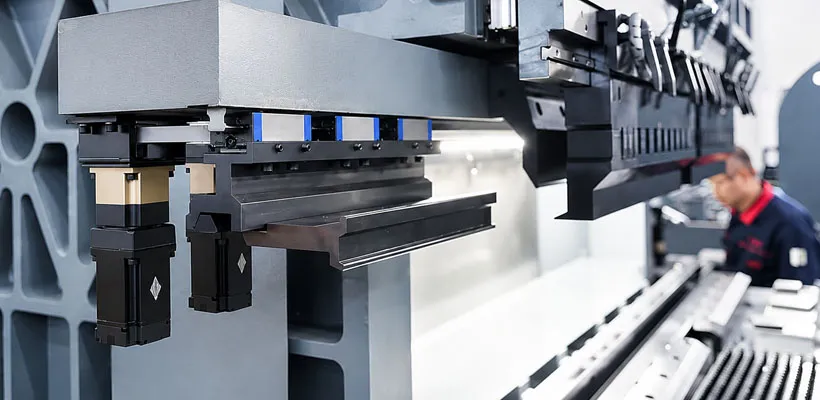
Close-up of CNC bending tooling forming a steel door profile with an operator supervising
Forming. Closed-loop angle control holds the profile from one end of the leaf to the other.
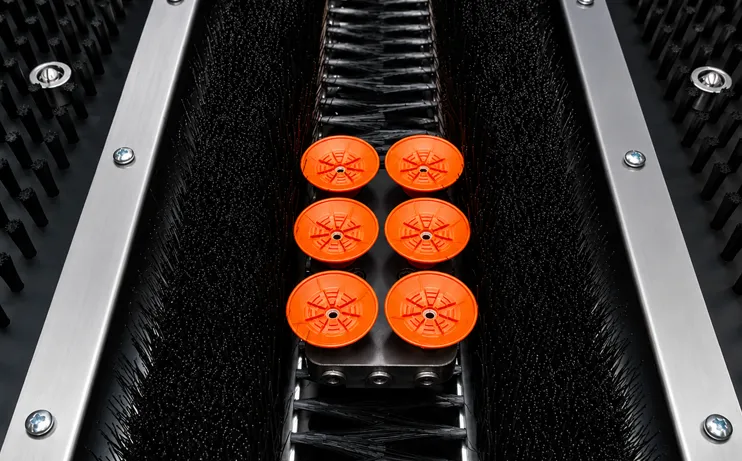
Brush and steel ball composite worktable on a STON panel bender, supporting door panels without scratching
Support. Brush-and-ball worktable matters for pre-painted and laminated door skins as much as for stainless.
Reality check

Three problems every steel door plant runs into

None of these show up as a rejected part. They show up later, at assembly or at the hanging stage, which is exactly why they are expensive.

ПРОБЛЕМА 01

The bend is right in the middle and wrong at the ends

Bend a 2,100 mm door leaf on a conventional press brake and the machine itself deflects under load — the ram bows, the bed bows, and the angle you set in the middle is not the angle you get 900 mm away. On a short bracket nobody notices. On a door leaf it becomes a wind gap at the top, a binding edge at the bottom, and a fitter on site with a grinder. The fix is not a better operator; it is deflection compensation and closed-loop angle control across the full bed.

UNCOMPENSATED — ram and bed deflect apart under load ram bed tight open tight The punch penetrates less at the centre, so the middle of the leaf comes out at a more open angle than the two ends. COMPENSATED — crowning plus closed-loop angle control Same penetration end to end, so the same angle end to end.
Why long-leaf door work is a machine problem, not an operator problem.
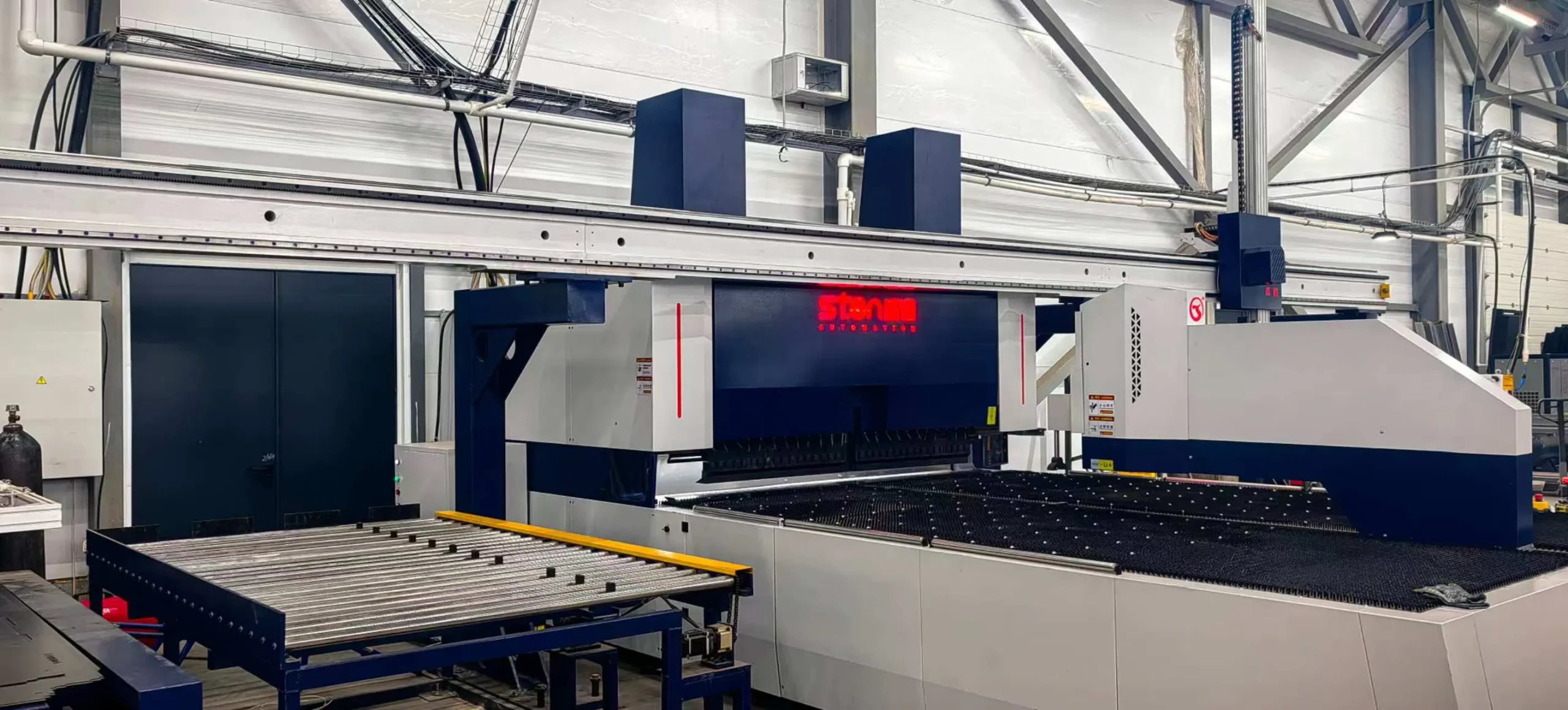
STON panel bender with loading and unloading robot installed at a fire door manufacturer
ПРОБЛЕМА 02

Every edge profile is another setup

A security or fire door edge is rarely one bend. It is a hem, an offset, a return flange and a sealing lip, sometimes a reverse fold. On tooling-dependent equipment each of those is a die change, a test piece and a requalification — and the sheet gets repositioned between every one of them, which is where both the time and the positional error come from. A panel bender or a flexible edge bender forms the whole profile in one clamping, so the sequence stops being a setup problem and becomes a program.

Dense perforated screen panel being processed on a STON CNC turret punching machine at a door plant
ПРОБЛЕМА 03

Volume goes up, so headcount goes up with it

Door plants live on delivery dates and thin margins. The usual way to add output is to add a shift and a pair of operators per station — which scales cost exactly as fast as it scales output, and gets harder every year as bending operators become harder to hire. Automating the leaf line breaks that link: one operator supervises the cell instead of feeding it, and the second shift no longer depends on finding two more people who can bend a 2,100 mm panel consistently.

What these three have in common. They are all discovered downstream — at assembly, at hanging, or in the delivery schedule — not at the machine that caused them. That is why door plants tend to under-estimate what they cost, and why the payback on a forming upgrade is usually larger than the labour arithmetic alone suggests.

Recommended configuration

What to buy, by production volume

Three configurations cover almost all steel door work. Which one applies depends on your leaf length and how much of your range is frames, so send a section drawing rather than guessing from the tier names.

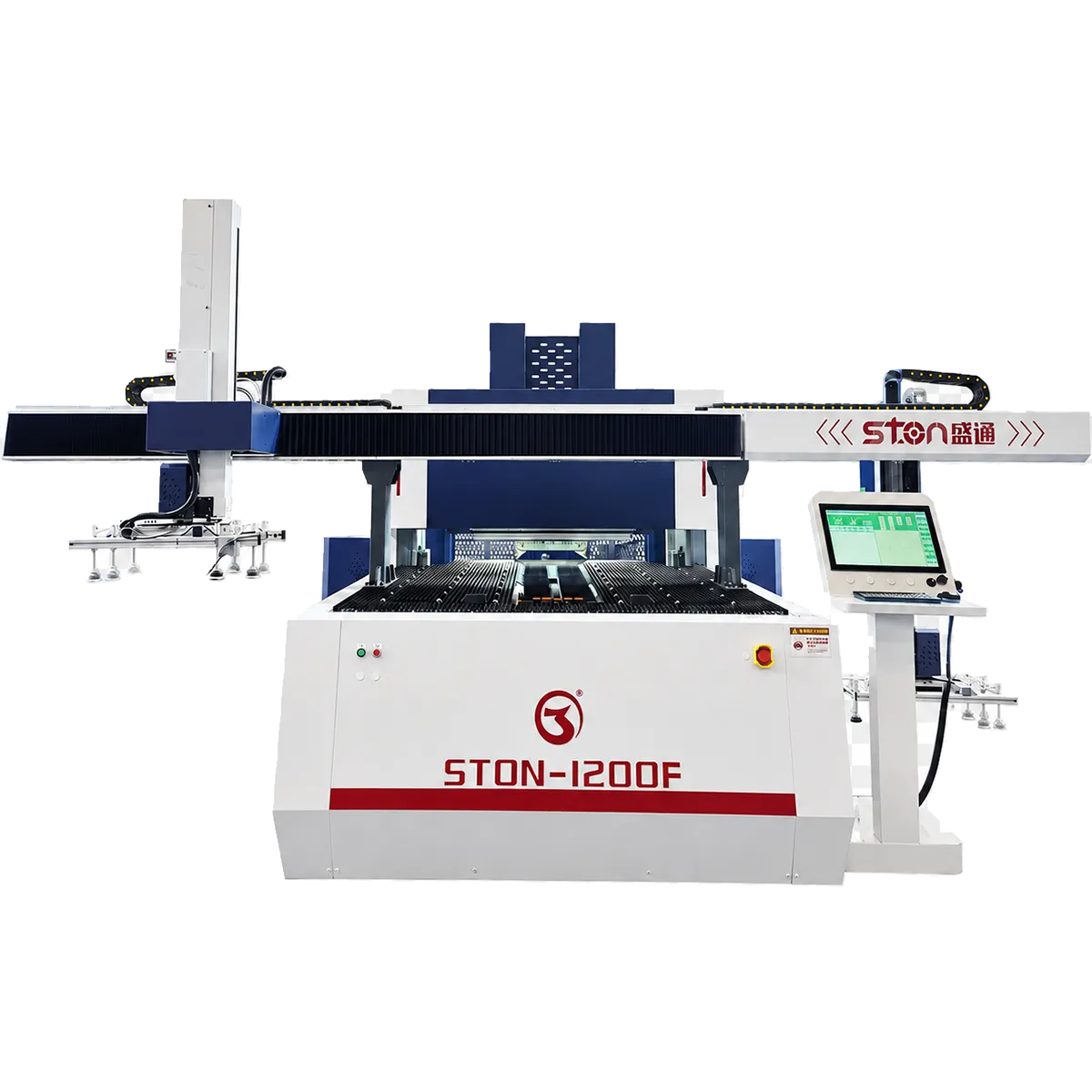
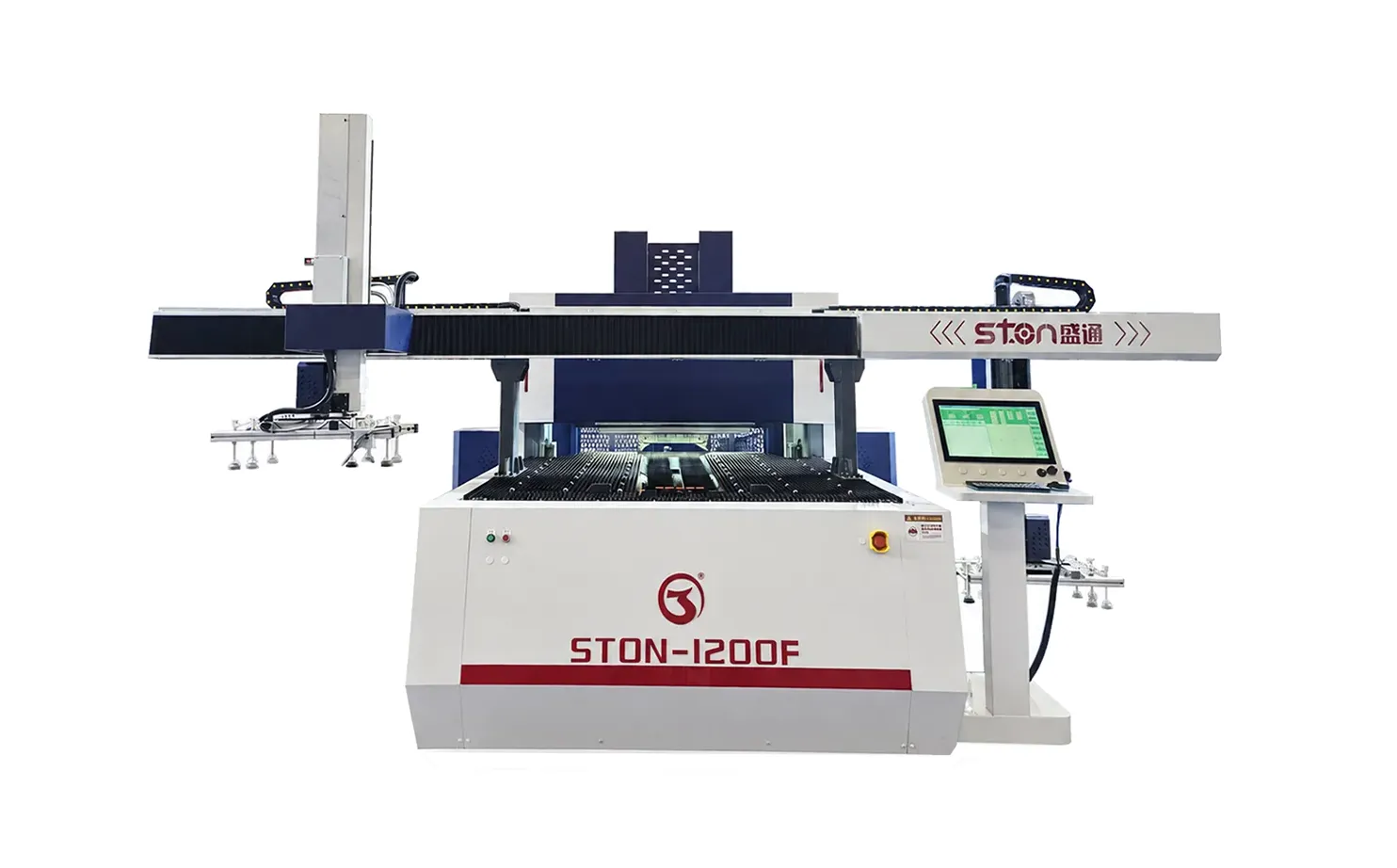
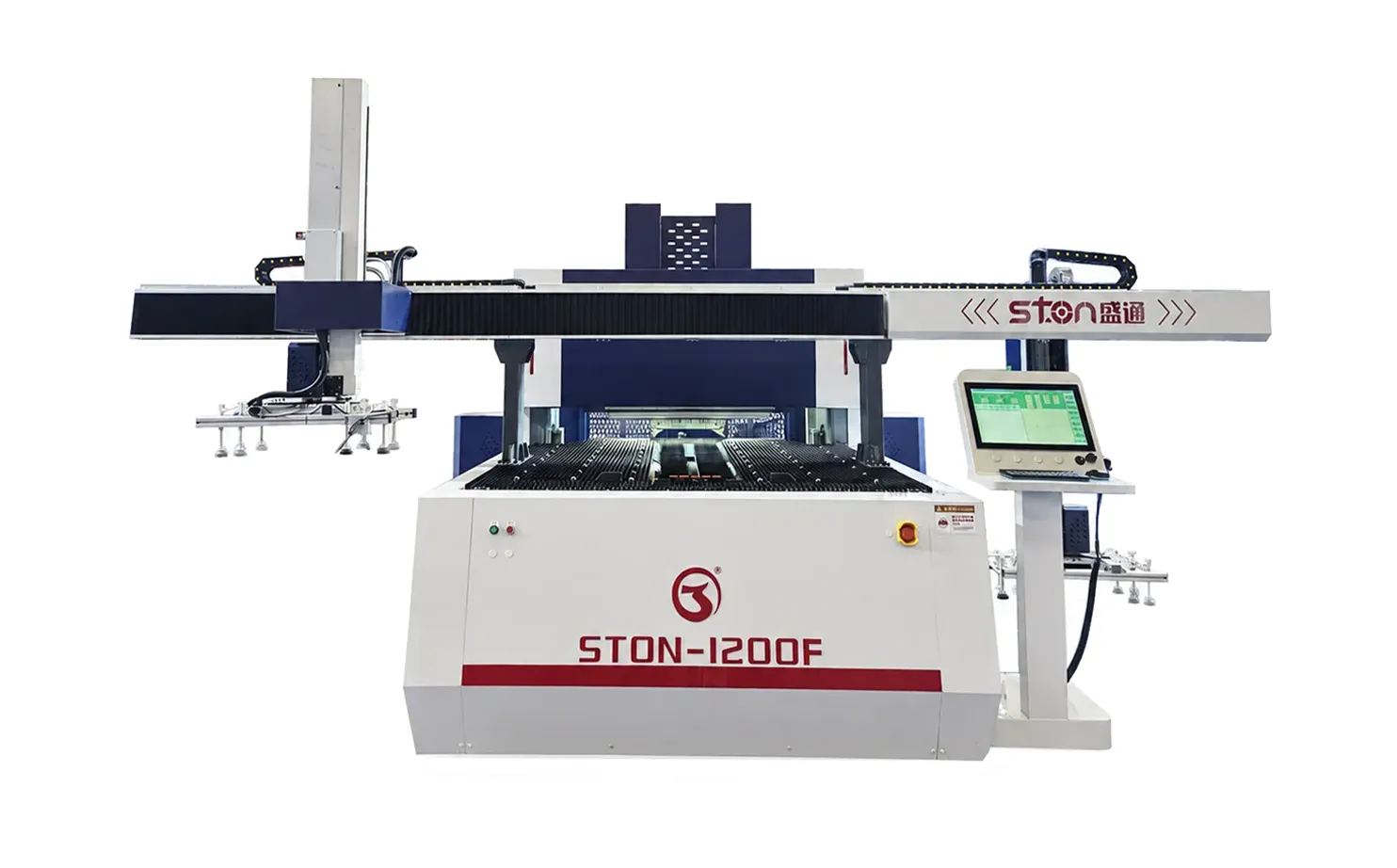
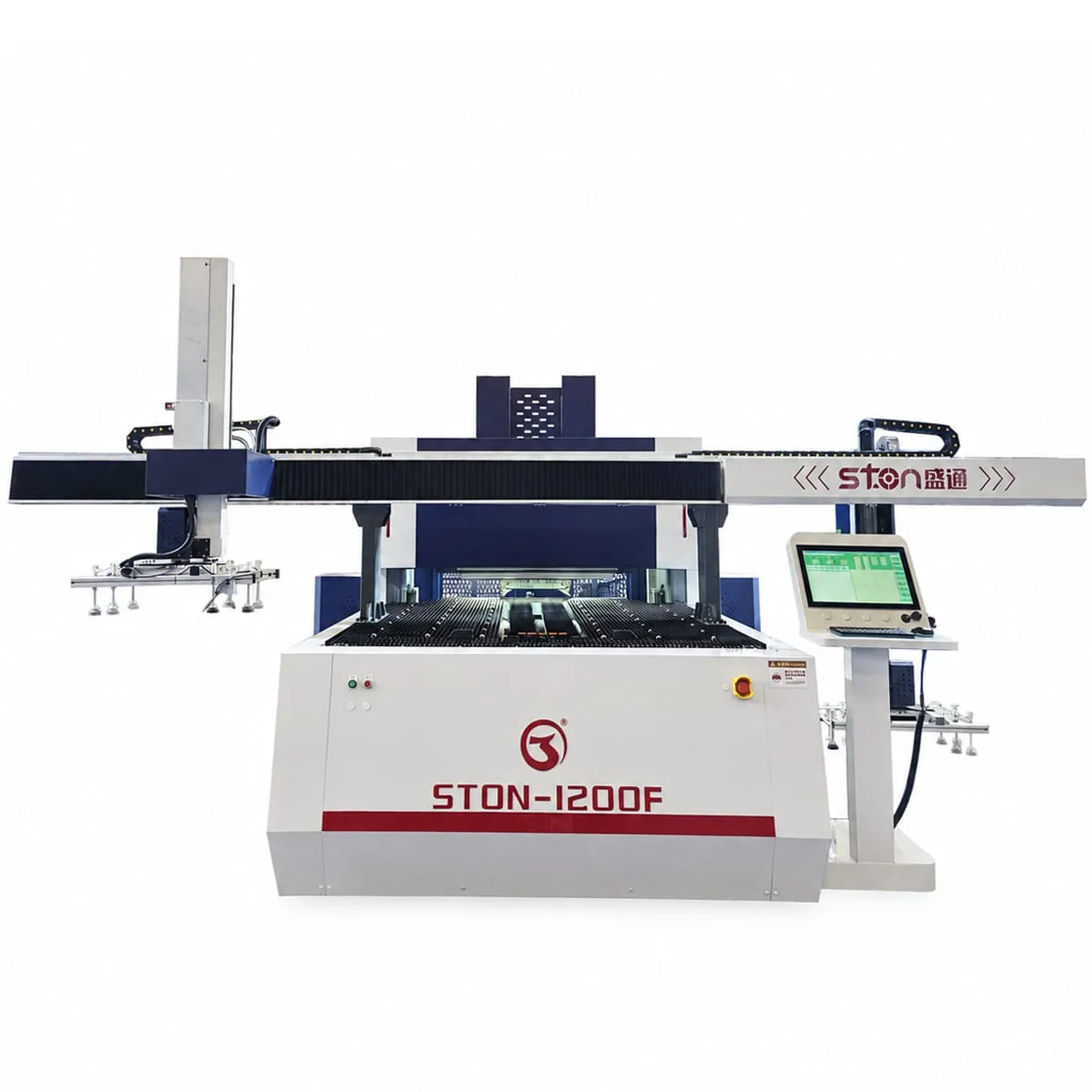
STON STON-1200F flexible edge bending machine for door leaf edge profiles
Entry — one product family

Flexible edge bender, existing blanking

If your bottleneck is the leaf edge and your skins are 1.2 mm or under, a Flexible Edge Bending Machine (1200 / 1600 / 2000) is the smallest change that fixes it. Forward folding, reverse folding, arc and step bending in one automated cycle with no tooling changes. Frames stay on whatever you bend them on today.

STON CNC press arm panel bender for full-height steel door leaves
Mid — full door range

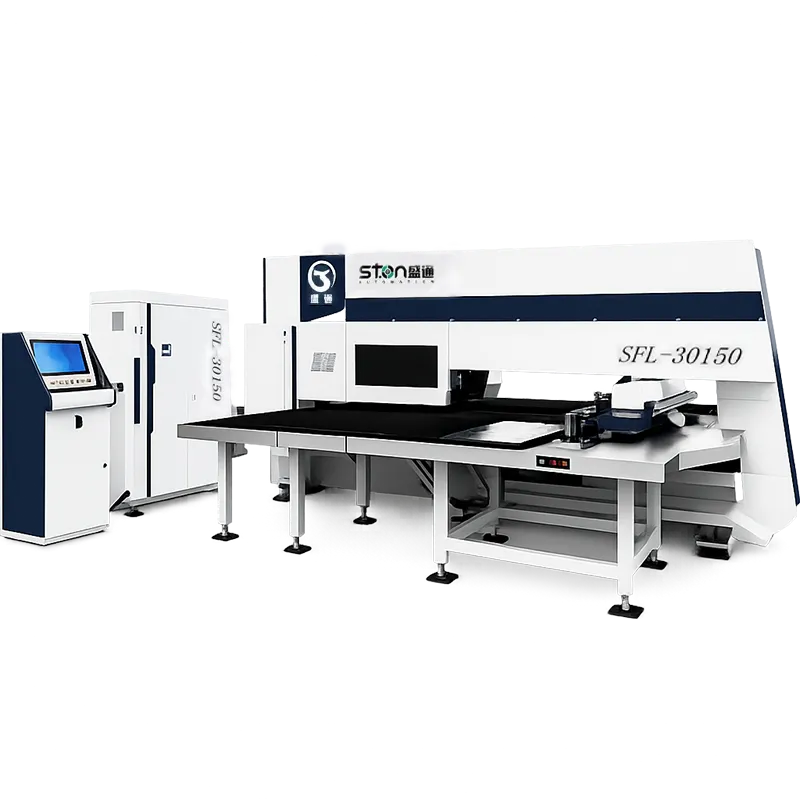
Turret punch + panel bender

The configuration most door plants end up with. A CNC turret punch puts every lock, hinge and vision cut-out in with one setup; a Press Arm Panel Bender (to 4,100 mm) forms full-height leaves in one clamping. This is the pairing supplied to the door plant in Kazakhstan documented below.

STON panel bender with loading and unloading robot in a door production workshop
High — continuous, multi-shift

Panel bender + loading/unloading robot

Add a loading and unloading robot to cover sheet pickup, positioning, transfer and stacking. The operator supervises rather than feeds, and an unmanned shift becomes realistic. This is the configuration running at the fire door manufacturer in Russia documented below.

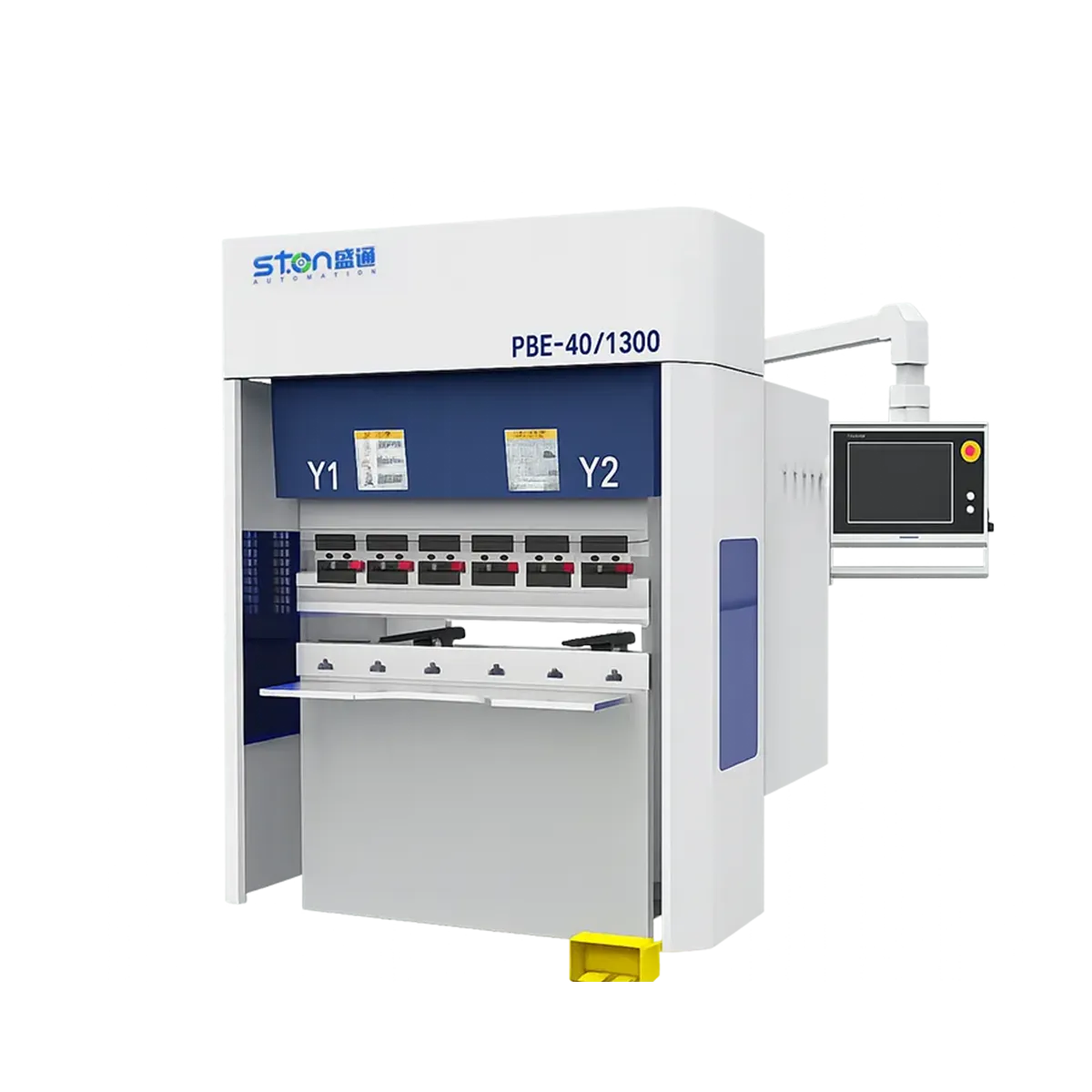
Frames are their own decision. Extra-long steel door frames often justify a tandem press brake alongside the leaf line — that is exactly what was supplied to the door manufacturer in Mexico. Cross-reference: if you also produce enclosures or cabinets, the punching-led configuration on our electrical cabinet equipment page shares most of the same machines.
Честные ограничения

Что эти машины могут, а что не могут формовать

Door work spans a wider thickness range than most sheet metal industries, which is why the machine choice splits. Here is where each one actually stops.

STEEL DOOR MATERIALS — THICKNESS AND WHICH MACHINE COVERS IT 0.5 1.0 1.5 2.0 2.5 3.0 sheet thickness (mm) Door leaf / skin 0.6 – 1.2 mm — most of your volume Flexible edge bender limit hard stop at 1.2 mm — it is a thin-sheet machine Frame / jamb profile 1.2 – 2.0 mm Turret punch capability up to 6.35 mm — punching is never the constraint Above 2.5 mm, long bends press brake only — tandem if the frame is extra-long
The 1.2 mm line is the one that decides most door-plant equipment arguments. Punching capacity is not the limit; forming is.
ПараметрSteel door production window
Bending lengthFlexible Edge Bending Machine: 1200 / 1600 / 2000 models — leaf and trim edges.
Press Arm Panel Bender: 1,000–4,100 mm — full-height leaves in one clamping.
Press brake: sized to the frame, tandem configurations for extra-long door frames.
MaterialGalvanised and cold-rolled steel, pre-painted and laminated skins, stainless for entrance and clean-room doors.
ThicknessLeaf skins typically 0.6–1.2 mm; frames 1.2–2.0 mm. The flexible edge bender is built for thin sheet up to 1.2 mm and does not go above it — frames go on the panel bender or the press brake.
Edge profilesForward folding, reverse folding, arc bending and step bending in a single automated cycle with no tooling change; hems, offsets, return flanges and sealing lips formed without repositioning the sheet.
Пробивка32-station turret (16A, 11B, 3C, 2D including rotary stations), ±0.1 mm machining accuracy, Y-axis throat 1,250–2,500 mm, sheet up to 6.35 mm. Servo series 405 hits/min; mechanical series from about 3 kWh per hour for cost-sensitive volume work.
Angle consistencyHeld by deflection compensation and closed-loop control across the full bend length rather than by operator positioning. The achievable figure for your leaf is quoted against your drawing — see the note below.
АвтоматизацияLoading and unloading robot covering pickup, positioning, transfer and stacking, for unmanned or lightly supervised shifts.

Where a panel bender is the wrong machine. Heavy frame sections above roughly 2.5 mm, deep-drawn or stretch-formed parts, very narrow profiles where the flange is shorter than the tooling can grip, and one-off prototypes where programming outweighs the run. Door plants normally keep a press brake for frames and run it alongside the leaf line — that is the correct answer, not a compromise, and it is what the Turkish and Mexican projects below actually did.

Fire doors: what the equipment does and does not give you. A fire rating belongs to the finished door and is established by your own test report and certification body. No forming machine confers it, and we will not imply otherwise. What the equipment contributes is the dimensional and edge-profile consistency that your tested configuration depends on — a leaf that is built the same way every time is the precondition for the test report meaning anything in production. If your certification requires specific edge geometry or tolerances, send those requirements with the drawing and we will confirm in writing whether the configuration holds them.

Why we do not publish a single tolerance figure. Angle repeatability over a 2,100 mm leaf depends on the material batch, the section profile and the flange layout as much as on the machine. A number on a web page that is not tied to your drawing is not something you can hold us to. Send the section and we will put an achievable figure on the quotation.

Process choice

Panel bender, flexible edge bender, or press brake?

This is the decision door plants actually agonise over, and the answer is usually "two of them". Here is what separates them.

  Панелегибочный станок STON CNCГибочный станок для панелей с ЧПУ STON flexible edge bending machineFlexible Edge Bender STON CNC press brakeЛистогибочный пресс с ЧПУ
Лучше всего подходит дляFull-height door leaves, four-sided panels, multi-angle profiles.Leaf and trim edges on thin skins — hems, arcs, step bends.Frames, jambs, sills, anything heavy or one-off.
Thickness ceilingComfortable across leaf gauges; drops off on heavy frame sections.Hard limit 1.2 mm. A thin-sheet machine by design.The highest of the three — sized to the job.
LengthTo 4,100 mm in one clamping.1200 / 1600 / 2000 models.Sized to the frame; tandem for extra-long.
Multi-step edgesWhole profile in one clamping.Forward, reverse, arc and step bending in one cycle, no tooling change.One bend per setup; dies change between steps.
Consistency down a batchProgram-controlled, closed loop.Program-controlled, closed loop.Depends on the operator and the shift, unless compensated.
ChangeoverProgram change.Program change, no molds.Die change plus a test piece.
OperatorsOne, and one can supervise more than one cell.One.Often two on a long frame.
The pattern in our own door projects: leaf on a panel bender or edge bender, frame on a press brake, holes on a turret punch. Three of the four documented projects below bought exactly two forming machines for this reason.
Production flow

From flat sheet to a hung door

Four stages, and the discipline through all of them is that position data is set once and never re-established by hand.

1 Blanking Leaf and frame blanks cut to size from coil or sheet. 2 Пробивка Lock, hinge, vision and louvre features — all in one setup. 3 Формование Leaf edges in one clamping; frames on the press brake. 4 Assembly Skins, core, frame and hardware — where upstream drift shows up. THE POINT OF STAGES 2 AND 3 Lock and hinge positions are established once, in one punching setup, and the edge profile is formed in one clamping. Nothing downstream has to re-find a datum, which is why stage 4 stops producing surprises.
The steel door flow. A loading and unloading robot can bridge stages 2 to 4 for unattended running.
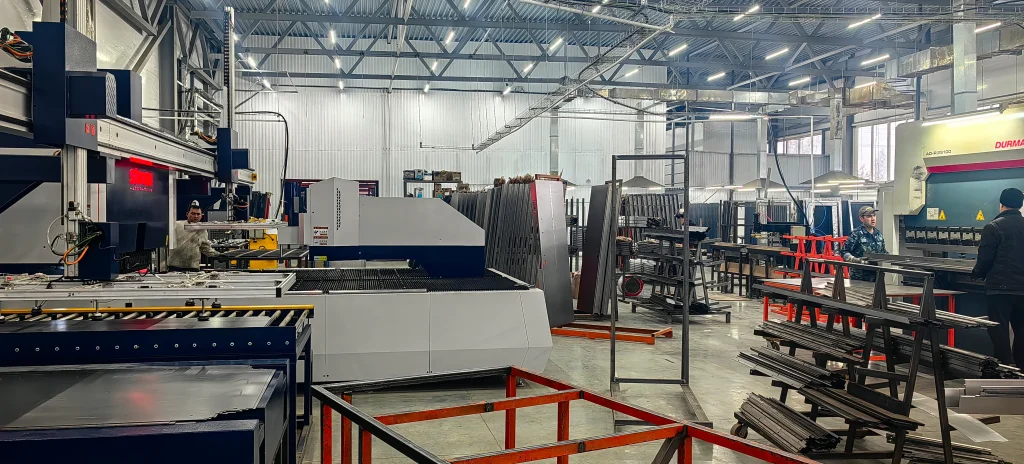
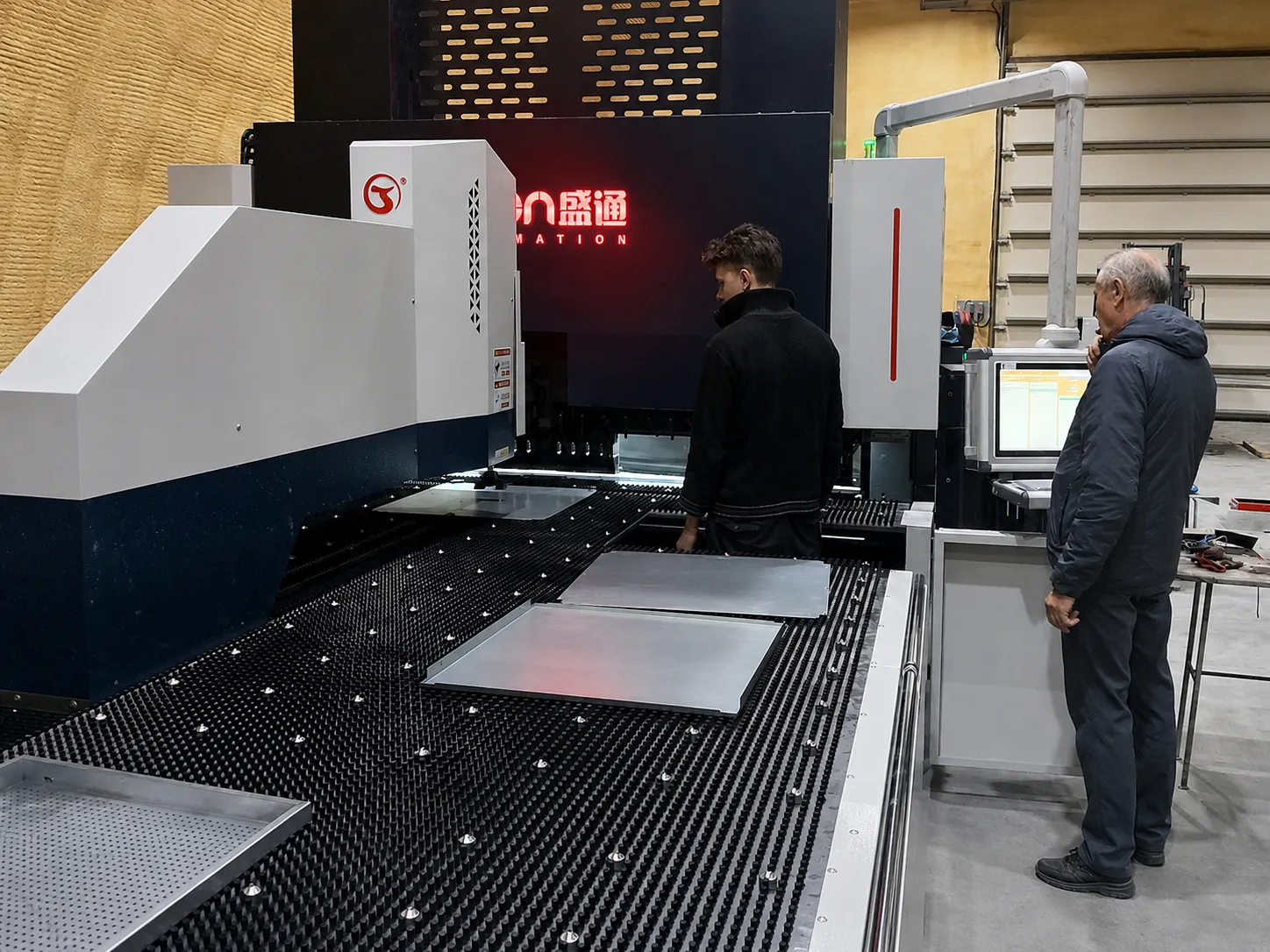
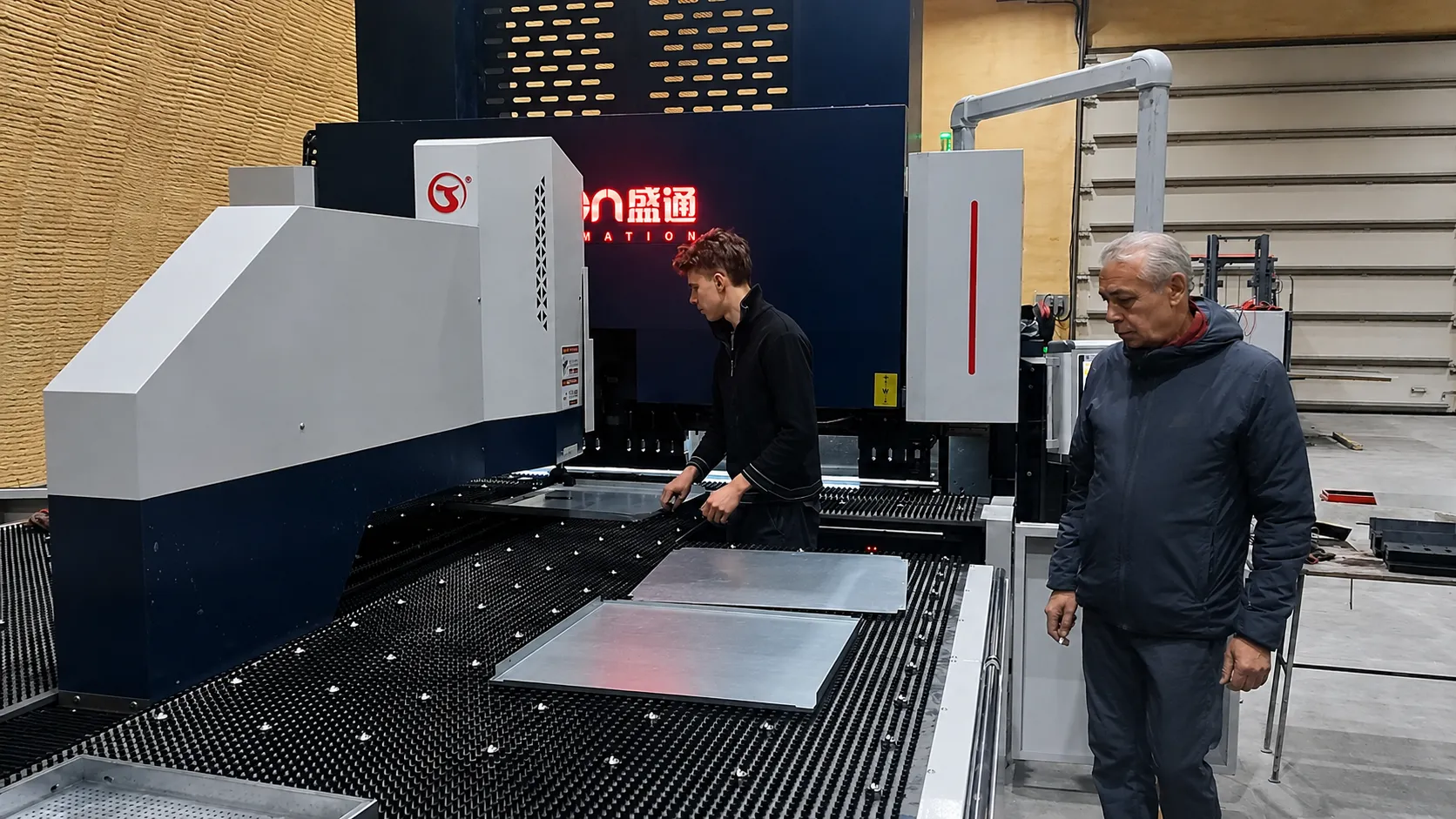
STON CNC turret punching machine installed in a door manufacturing workshop
Stage 2 — turret punching at the door plant in Kazakhstan.
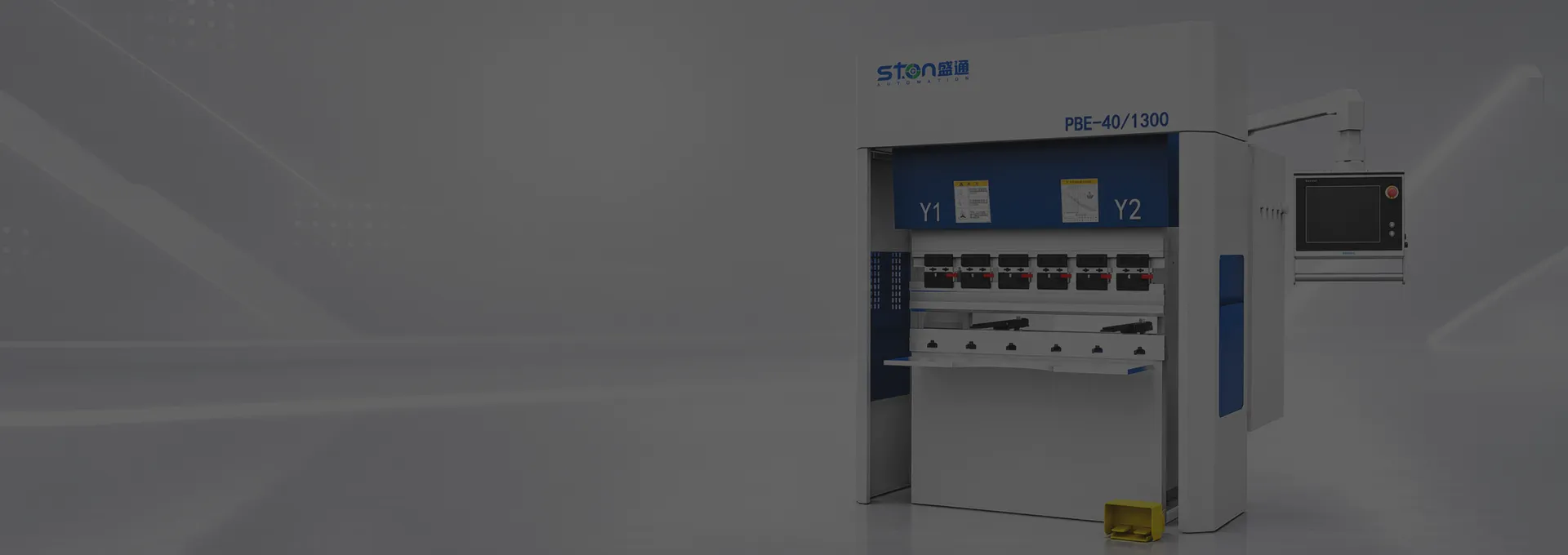
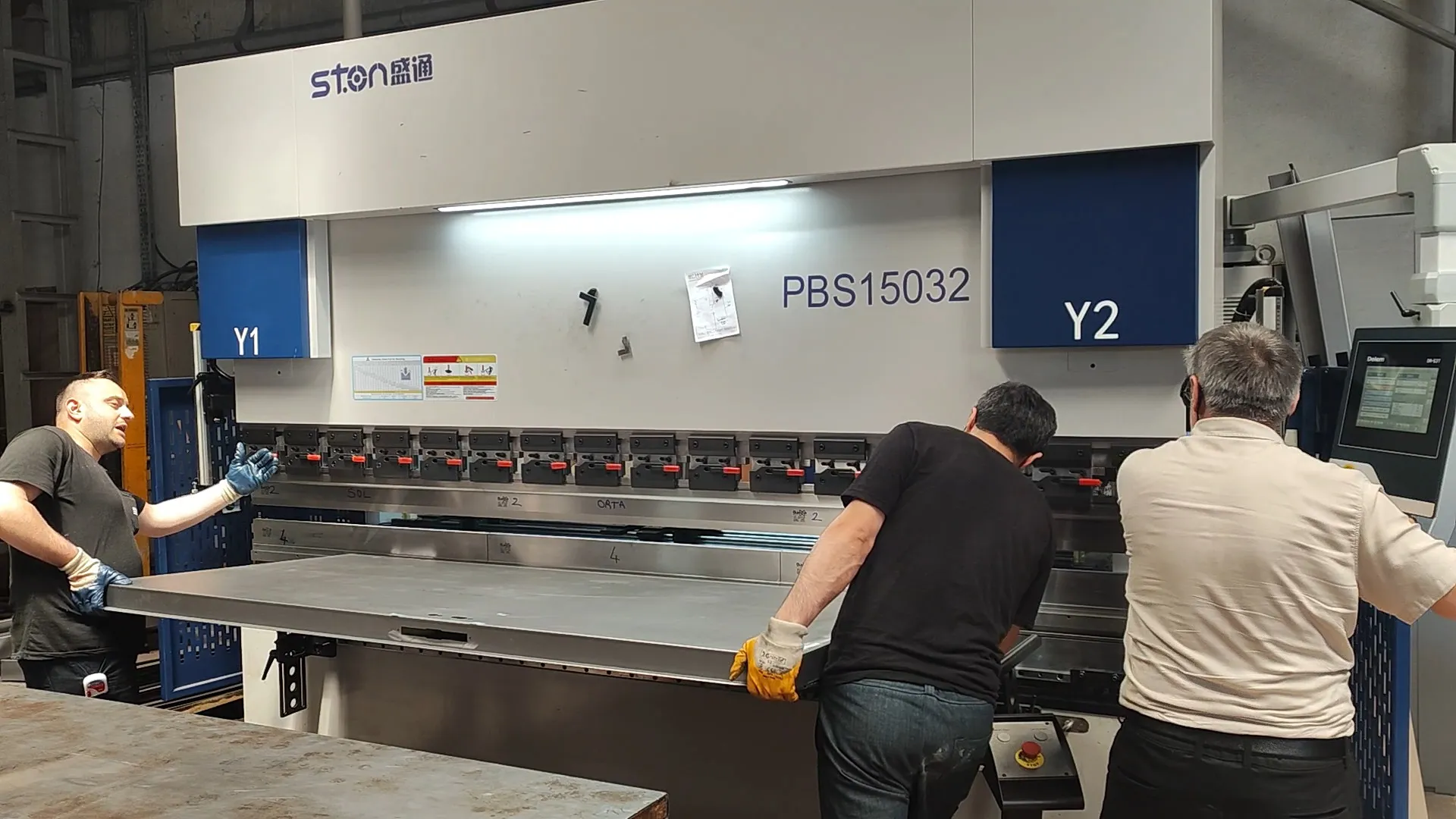
STON PBS press brake being operated at a door manufacturer in Turkey
Stage 3 — frame bending on a STON press brake in Turkey.
Formed fire door panels stacked on racks after bending
Stage 4 ready — formed fire door panels racked for assembly, Russia.
Equipment

Оборудование, стоящее за этим решением

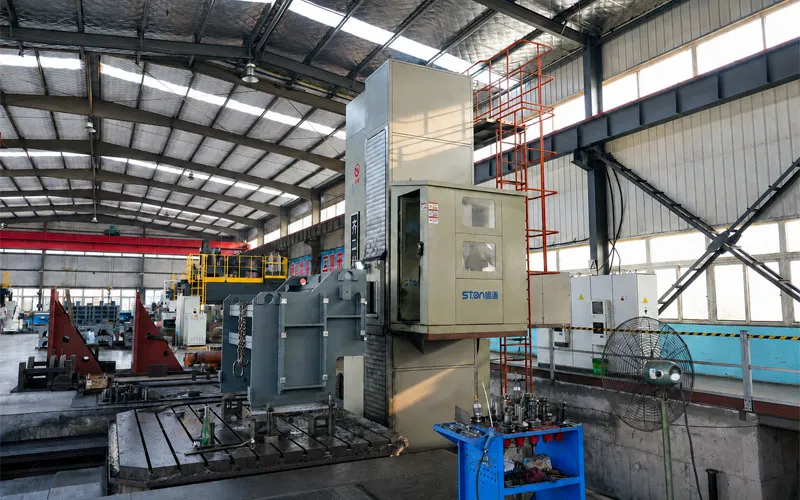
STON has built CNC sheet metal machines since 2006, in a 20,000㎡ plant we own, with beds cast and machined on our own gantry centres. The person who answers a technical question about your machine works in the building where it was made.

STON CNC panel bender for steel door leaf forming
Leaf forming

Гибочный станок для панелей с ЧПУ

Press arm type to 4,100 mm and suction type for shorter panels. Multi-angle door profiles, hems and return flanges in a single clamping, with closed-loop angle control across the full bend length.

View panel benders
STON flexible edge bending machine with automatic loading and unloading for steel door edge profiles
Edge profiles

Станок для гибки гибких кромок

Built for thin sheet up to 1.2 mm. Forward folding, reverse folding, arc bending and step bending in one automated cycle with no molds. All-electric servo closed-loop control supporting up to 25 axes of concurrent linkage. Models 1200 / 1600 / 2000.

View edge bending machines
STON CNC turret punching machine processing a steel door blank
Cut-outs

Координатно-пробивной пресс с ЧПУ

32-station turret (16A, 11B, 3C, 2D including rotary), ±0.1 mm accuracy, Y-axis throat 1,250–2,500 mm, sheet up to 6.35 mm. Servo series 405 hits/min; mechanical series from about 3 kWh per hour for cost-sensitive volume.

View turret punches
Also used on door lines: Гидравлические листогибочные прессы с ЧПУ including tandem configurations for extra-long frames, loading and unloading robots for unattended running, and fiber laser cutting where contours are too irregular to punch. Not sure which combination applies? Start from the equipment selection guide, or see the elevator panel page if you also build cabin and landing door panels.
Соответствие

Сертификации и экспортное соответствие

What we hold, what our machines are designed to, and — for fire doors specifically — what equipment certification does not cover.

ISO 9001
Certified quality management system covering design, manufacture and service.
CE marking
Machines for the European market are supplied CE marked under Machinery Directive 2006/42/EC.
Designed to EN ISO standards
Safety design follows EN ISO 12100 and safety-related control functions EN ISO 13849-1.
80+ markets served
Export documentation, T/T and L/C terms and commissioning arranged per destination.

Fire door certification is yours, not ours. These certifications cover the machine. A fire rating covers the finished door and comes from your own test report and certification body — no bending or punching equipment grants it. Saying otherwise would be misleading, so we do not. What we can do is confirm in writing whether a proposed configuration holds the edge geometry and tolerances your tested design depends on. Send those requirements with the drawing.

Почему STON

An original manufacturer, from casting to commissioning

Founded in 2006, STON is not an assembler or a trading company. Machine beds are cast, stress-relieved and machined on our own gantry processing centres and CNC floor-standing boring machines, then assembled and calibrated inside our 20,000㎡ Qingdao facility. Full-link independent processing is what lets us hold assembly accuracy within ±0.05 mm and guarantee lifetime parts supply.

For door work specifically, that matters because long-leaf angle consistency comes from a frame that was stress-relieved properly — a step no one can verify for you from a catalogue.

2006Производство с
20,000㎡Собственное предприятие
80+Countries served
100+Патенты и сертификаты
STON CNC heavy machining workshop in Qingdao where machine beds are machined in-house
Heavy machining workshop, Qingdao. Machine beds are machined here, not bought in.
STON CNC client STON CNC client STON CNC client STON CNC client STON CNC client
Documented projects

Four door manufacturers, four different configurations

These are real STON installations at door plants, with the equipment actually supplied and photographs from each site. We have deliberately not attached productivity percentages to them — those figures belong to the customers, and we publish them only once a customer has signed off on the numbers.

STON CNC turret punching machine and panel bender installed at a door manufacturer in Kazakhstan
Казахстан

Doors and dense screen panels

Industry
Door & dense screen manufacturing
Equipment
CNC Panel Bender + Mechanical Turret Punching Machine
Processes
Sheet metal punching and panel bending

The punching-plus-bending pairing, handling both door panels and heavily perforated screen panels in the same workshop.

Read the project
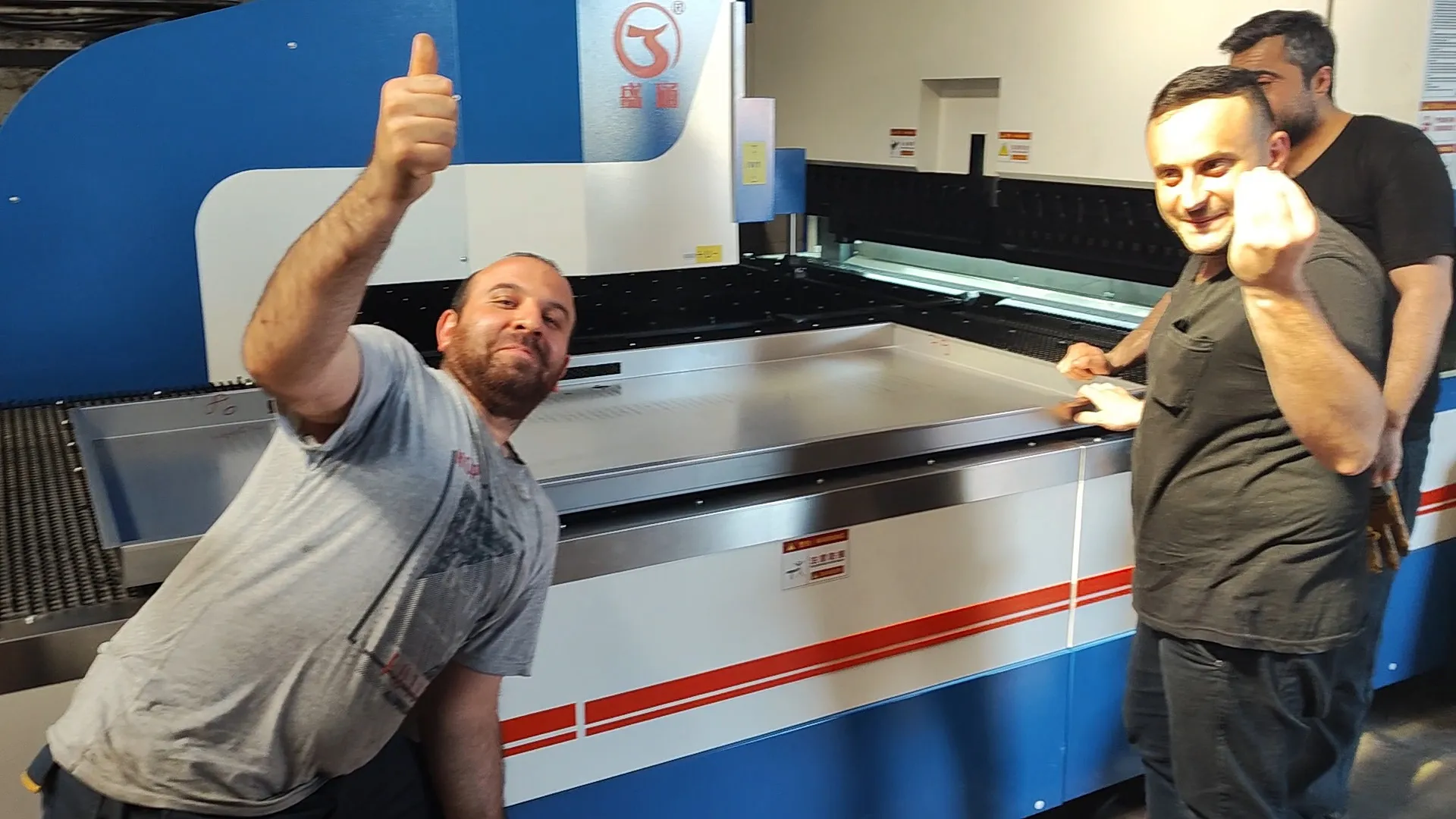
Customers at a Turkish door manufacturer beside their STON CNC press brake
Турция

Leaf forming plus general bending

Industry
Door manufacturing
Equipment
CNC Panel Bender + Press Brake
Workpieces
Door panels, frames and related components

The two-machine pattern described above: repeated multi-edge forming on the panel bender, general-purpose flexibility on the press brake.

Read the project
Панелегибочный станок STON с роботом загрузки и выгрузки на предприятии российского производителя противопожарных дверей
Россия

Fire door panels, automated

Industry
Производство противопожарных дверей
Equipment
Panel Bender + Loading and Unloading Robot
Автоматизация
Loading, positioning, bending, unloading, transfer

The high-volume configuration. The robot handles sheet pickup, positioning, transfer and removal of processed panels around a programmed multi-edge bending cycle.

Read the project
Сформированные полотна стальных дверей, установленные на стеллажи после гибки на предприятии по производству дверей
Мексика

Extra-long steel door frames

Industry
Steel door and frame manufacturing
Equipment
Customised tandem press brake system
Requirement
Angle consistency over extra-long frames

The frame-side answer. This customer needed bending accuracy and long-panel stability over lengths a single press brake could not hold, so the system was built to their frame length.

Read the project
Want the equivalent for your product range? Send a door section drawing and we will tell you which of these four configurations is closest, and what it would cost.
Часто задаваемые вопросы

Часто задаваемые вопросы

The questions steel door manufacturers actually ask before they order.

Can a panel bender hold the same angle along a 2,400 mm door leaf?

That is the specific problem it is built for. Bend geometry is held by deflection compensation and closed-loop control across the full bend length rather than by an operator positioning the sheet against a backgauge, which is where drift on a conventional press brake comes from. We quote the achievable figure against your section drawing rather than publishing a general number — it depends on your material batch, profile and flange layout as much as on the machine.

Can it produce dead edges, offset bends and return flanges?

Yes, and in one clamping rather than one setup per feature. The flexible edge bending machine additionally does forward folding, reverse folding, arc bending and step bending in a single automated cycle with no tooling change. Security and fire door edge profiles are the usual reason customers ask, and they are standard work.

What is the thickest material you can form?

It depends which machine. The flexible edge bender is a thin-sheet machine with a hard ceiling of 1.2 mm. Door leaf skins at 0.6–1.2 mm sit inside that; frames at 1.2–2.0 mm go on the panel bender or the press brake; heavy sections above roughly 2.5 mm are press brake work. Punching is not the constraint — the turret punch handles up to 6.35 mm.

Do you have fire door certification?

No, and neither does any other equipment maker — a fire rating belongs to the finished door and comes from your own test report and certification body. Our machines carry their own CE marking under 2006/42/EC. What the equipment contributes to your certification is the dimensional and edge-profile consistency your tested configuration depends on. If your certification specifies edge geometry or tolerances, send them with the drawing and we will confirm in writing whether a configuration holds them. We do have a fire door manufacturer in Russia running a STON panel bender with a loading and unloading robot — the project is documented above.

How much faster is this than manual press brake bending?

It depends entirely on your current edge profile and batch size, so a single multiplier would be marketing rather than information. The honest way to answer it is against your own part: send a section drawing and a current cycle time and we will give you a like-for-like comparison for the specific profile, including the setup time the panel bender removes rather than only the bending time.

Is unattended or night-shift running realistic?

Yes, with a loading and unloading robot covering pickup, positioning, transfer and stacking, which is the configuration running at the fire door manufacturer in Russia. Without automation the machine still needs someone to load it. Whether an unattended shift makes sense for you is mostly a question of batch size and panel mix, and it is worth working through before you buy rather than after.

Can the machine handle pre-painted or laminated door skins?

Yes. The worktable uses a brush-and-steel-ball composite surface that supports the panel on rolling and yielding contact instead of dragging it across flat steel, and suction-cup handling lifts on the reverse face. Tell us the coating or film type with the drawing, because it affects both the bending allowance and how the suction cups grip.

What about frames — do we need a separate machine?

Usually yes, and we would rather say so. Frames are thicker, longer and bent differently from leaves, and a press brake does that job better. Three of the four door projects documented above bought exactly two forming machines for this reason; the Mexican customer needed a customised tandem press brake specifically because their frames were extra-long.

What power and compressed air supply is needed?

It varies by model and by the automation attached, so exact figures come with the quotation for your configuration. As an indication of the range, the mechanical turret punch series runs from about 3 kWh per hour. Tell us your supply voltage and frequency up front — machines are built to the destination's supply rather than converted on arrival.

What is the price range?

Too much depends on bending length, machine type and automation level for a single figure to mean anything. A door section drawing and a target daily output gets a specific written quotation, normally within 24 hours, which is a faster route to a real number than any range we could print here.

Поставляются ли станки с документацией CE?

Machines supplied to the European market are CE marked under Machinery Directive 2006/42/EC, with safety design following EN ISO 12100 and safety-related control functions following EN ISO 13849-1. The exact document set differs by destination market and is confirmed at quotation stage.

Can you ship to our market?

We export to more than 80 countries, with documented door-industry installations in Turkey, Kazakhstan, Russia and Mexico. Tell us where the machine is going and we will confirm shipping, documentation, terms and on-site commissioning support for that specific destination.

Как организованы поставка запасных частей и сервисное обслуживание за рубежом?

Because we manufacture the full machine including beds and structural parts in our own plant, parts are made to our own drawings and lifetime parts supply is part of what full-link independent processing buys you. A recommended spares package is quoted with the machine, remote diagnostics handle most issues, and on-site support is arranged per destination and agreed in writing before the order.

How do we verify our door section is feasible before ordering?

Send it. Our engineers review the leaf and frame sections, material, coating and edge profile, tell you which machines the range needs, flag anything that would need a design change, and confirm the achievable angle tolerance in writing on the quotation. There is no charge, and it is the step we would rather do too early than too late.

Следующий шаг

Send us your door section drawing

One leaf section and one frame section is enough. Our engineers will come back within 24 hours with the machines we would propose for your range, the achievable angle tolerance on those specific sections, and a written quotation.

  • Reviewed by engineers who build the machines, not by a sales desk
  • An honest split between what needs a panel bender and what needs a press brake
  • Tolerance confirmed against your drawing, in writing on the quotation
  • No charge and no obligation
Get a quote
Tell us leaf size, skin thickness, frame section and daily output.

    Получить предложение

      Мы ответим вам в течение 24 часов. В срочном случае добавьте нас в WhatsApp/WeChat: +86 18153226091,. Или позвоните напрямую по номеру +86 18153226091.

      *Мы уважаем вашу конфиденциальность, и вся информация защищена.

      Мы будем использовать вашу информацию только для ответа на ваш запрос и никогда не будем отправлять нежелательные электронные письма или рекламные сообщения.